Showing posts with label Apple computer. Show all posts

Wednesday, December 2, 2015

Computer collectors Museum - Peek at 300 items on display - Bugbook Computer Museum

Bugbook
Bugbooks
david Larsen, KK4WW, N4USA
Inside our museum, Floyd Virginia 
Here is a folder of about 300 photos of items on display. This is about 3% of our collecting efforts of the past 40 years on display at our Museum. The other 97% of the collection is in our Museum warehouse. Our assistant curator Bryan Dowd made these photographs as part of his curator duty. I only wish I had made arrangements to photograph the whole collection as were were storing it in the warehouse. We don't have photos but do have 90% of the collection inventoried on a museum database software "Past Perfect".

Better - Visit our museum in Floyd Virginia and I will share a coffee or have lunch with you. We are located in the most beautiful part of the Blue Ridge Mountains just off the Blue Ridge Parkway  - milepost 165.

Click on photo to enlarge
Bugbook Computer Museum
 1958 Autonetics Recomp 2


One of the computers on display at the Bugbook Computer Museum. This is a 1958 Autonetics Recomp 2. A 200 lb portable transistorize computer. More about this computer "CLICK"

Take a tour and look at all the computers in the museum - very nice photos "CLICK".

View photos as slide Show

Visit Museum on Facebook (like would be nice)  Follow Museum on Twitter
________________________________________________________________

Here is an audio of my journey collecting the microcomputer  memorabilia. An interview recorded by Eric 4Z4UG's for his Podcast "QSO Today" "CLICK" for podcast. 
________________________________________________________________


Click photo to enlarge
David Larsen, kk4ww, n4usa
Chantilly Farm , Floyd Virginia
Visit the museum in Floyd and this is a view you will see  in our area  of the Blue Ridge Mountains. This is our farm about 1 mile from the Blue Ridge Parkway MP 160. We call this "Chantilly Farm" (Take look "CLICK") and it is a festival and event farm. We also have ham radio station in the officer here N4USA and 2 campgrounds. One of the campgrounds has 25 full service RV campsites that are Ham Radio Friendly. Lots of wild game and trails for hiking or biking. When not working at the Computer Museum you will find me at the farm.


______________________________________________________________________

David Larsen

I hope you enjoyed looking at some of the photos taken in our museum. Better yet visit and see the museum and eclectic community of Floyd, Virginia.  Thank you for reading my blog and have a wonderful holiday season for 2015. Dave


Sunday, June 21, 2015

Computer Museum Curator is a hoarder of good Memorabilia

Bugbooks
info click
These Gerber bottles are from 1963 when my son was born and I was working at Konel Electronics.  Konel made marine radio transmitters and used a lot of stainless steel hardware.  The hardware nuts and bolts that fell on the floor were just swept up and tossed in the trash. It was not worth the time to sort the little hardware pieces & I saved some useful items. Sidney Koningsberg  owner of Konel was a great fellow. He gave me my first job out of college in 1963 and loaned me $3000 for a down payment on my first house.

Click on photo to enlarge 
David Larsen, Computer Musem
Konel Marine Radio Transmitter  1963


This 52 year old Gerber bottles may be collectible items however  for me they just contain useful hardware from 50 years ago. I find uses for this hardware often.

A  video of hoard of Gerber Baby Bottles "CLICK"


Gerber Baby food bottles


Some have red tops and some blue - I don't know just what that indicated. A bottle collector would know.


Computer museum, david Larsen
Konel Marine Radio Transmitter 

I saved some of the discarded stainless hardware nuts and bolts for my own use. I used these Gerber jars to store the little nuts and bolts and here we are more then 52 years later with the remaining hardware. It has been useful all these years to be able to use the hardware as needed and it is often I do need a few of these parts for repair.


Click on photo to enlarge 
Konel Marine Radio Transmitter 


More hardware -  I have about 10 of this bottles with various hardware items stored.


Computer museum, curator
Konel Marine Radio Transmitter 
This is where I gathered the hardware stored in the Gerber bottles 53 years ago.
This Konel Marine Radio Transmitter was built by the company I worked for when I graduated from Oregon State University in June 1963. I had a lot of experience with transmitters and receivers - Ham Radio at 15 years old ( and still at it 61 years latter) - 2 years in Navy are Radio technician. I also worked 2 years during my Summers while in college for Mr. Koningsberg .

This Konel transceiver is on display in our museum.


Little video of this Konel transceiver "CLICK"
-------------------------------------------------------------------------------------------------------------------
A good day in the museum - 6-21-15


Computer Museum, David Larsen
Kids day 2015 Amateur Radio
Amateur Radio Station N4USA used to make contacts nation wide on this Kids Days - a special day when Amateur radio operators brings kids into their station for the experience of talking to other children direct by two way long distance short wave radio. At N4USA we made contact with stations and kids in NY, Montana, Illinois,and other states.
 Bugbook Computer Museum.www.n4usa.com www.fairs.org


computer Museum David Larsen
Kids day 2015 Amateur Radio


The Kids day ham operators L-R Matt Standberry, Mark Ward, David Larsen, & Tom King.


Bugbook Historical Microcomputer Museum
David Larsen

 Still having fun at 76 yrs. 

           ."by David Larsen"  KK4WW Computer Collector Historian 


Friday, November 28, 2014

Computer Museum Assistant Curator Emily Wilson is off to College

Floyd, Virginia 
Bugbook Historical Microcomputer Museum
LR David Larsen - Emily Wilson 
Bugbooks
info click
I am sad and glad today 11-25-14. Sad because Emily Wilson is leaving the position  of Assistant Museum Curator and glad because she is attending college to pursue a degree as a medical laboratory technician. I am always happy for our staff to move on to pursue their dreams.  Emily began work as Assistant Curator after High School graduation last June and has been a tremendous help to improve our museum. She worked on improving all the displays and was a great host to museum visitors.We will miss Emily and can only wish her well in this new adventure and career.

To enlarge "CLICK" on Photo
Bugbook Historical Microcomputer Museum
LR David Larsen - Emily Wilson 

Here is me your Museum Curator with Emily and some of our 20 cabinets and shelves of displays that she helped make into a welcome experience for our visitors. Emily helped make video's, QR codes for hearing a description of a vintage computer with a smart phone by just clicking on the code, writing description of many displays - & much more. Emily was great as assistant curator in our museum. Thank You , Emily for all the help.


Bugbook Historical Microcomputer Musem
Alice Cox - Planting trees at Chantilly RV Park
Alice Cox  has been helping at our Chantilly Farm and  occasionally at the museum. Alice will be working as Assistant Curator off and on as time allows. Alice came to work the same time as Emily after High School Graduation last Spring. Alice and Emily both started as Summer Interns and continued working into the Fall. Alice was off to college at Virginia Tech this fall however she had a great opportunity when voted in as the state office for FFA as state Recorder & continued here at the LCF group.  Her position with FFA for the year is not full time and when not assisting the FFA Alic is working with our LCF Group. Alice is mostly working as a manager at of the grounds at our Chantilly Farm just a few miles from the museum. We are delighted with the assistance Alice has provided as we develop the farm festival venue and new full service RV and Camp grounds.  She will continue her work here at the museum and farm for this school year and then start at Virginia Tech in the fall of 2015 working on her Agricultural Education degree.  We are sure happy to have her here for until she is off to college in the Fall of 2015.

David Larsen
We are all home for the Thanksgiving Holiday - several of our  team were without power for a few days but all is OK now Friday November 28th.  At our house we will have about 32 family members here for dinner - this is day after Thanksgiving however two turkeys are ready to be served. A Happy and Great Thanksgiving to all our readers and we will miss Emily when we start back at the Museum on Monday.


Thursday, November 6, 2014

Vintage - Apple-1 Computer Clone operational at the "Bugbook Historical Microcomputer Museum"

Bugbooks
info click
-------------------------------------------------------------------------------------------------------
NEWS FLASH - Bob Luther is selling his "First Apple 1 Computer"  December 11,2014 at Christie's Auction.  Sold for $365,000
-------------------------------------------------------------------------------------------------------
Click on photos to enlarge
bugbook Historical Microcomputer museum
Apple 1 clone display 
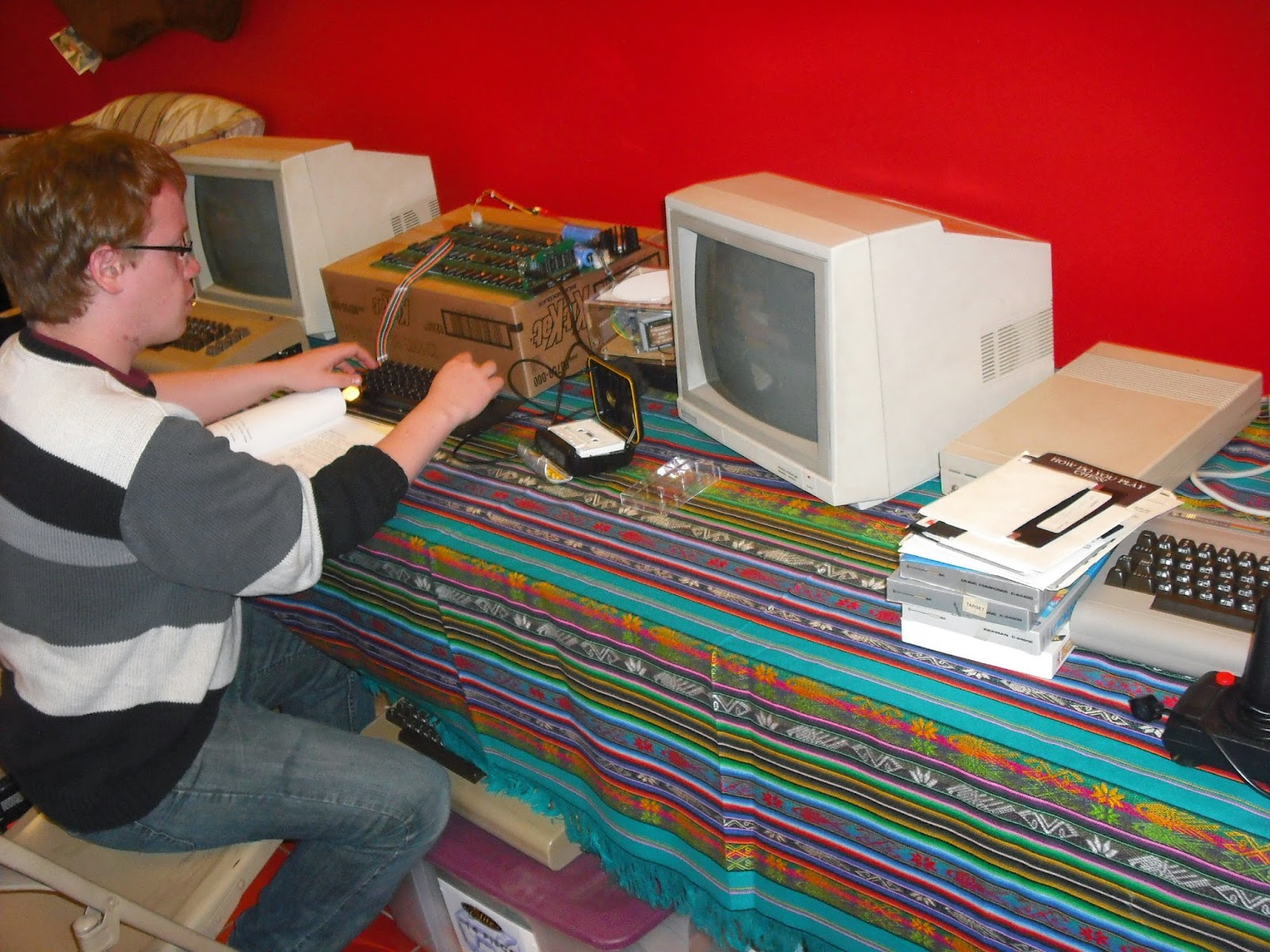
Apple-1 clone is operational and running programs just fine here in our museum. Grayson Van Beuren as part of his Graduate Independent Studies at Virginia Tech (VT) has been helping with interactive operational retro computers. This week the Apple 1 clone was tested and executes programs just fine. Grayson comes  to the museum every Friday for a several hours in the afternoon and we work together on projects for his studies. He is a very enthusiastic and a joy for me to spend time with in the museum. The museum is about a 50 minute drive from the VT campus and this study project takes up a lot of his Friday's.

Bugbook Historical Microcomputer Museum
Grayson Van Beuren

Grayson loading cassette Basic into the Apple-1. Basic loads fine using this old Walkman cassette player.


Grayson usually takes a vintage computer back to campus and works from home some Friday's. This is good use of his time and reduces his travel time to Floyd.


Bugbook Historical Microcomputer Museum
Running Apple 1 Basic 
The computer executes Basic just fine and is a popular display for our museum visitors.
Brandon Cholodenko assembled this Apple-1 clone for our museum by  starting with the Mimeo Apple-1 PC board from Mike Willegal. Brandon assembling of the Apple clone was great - it worked perfectly out of the box. 
This  Mimeo Apple-1 is just the ticket to get our original Apple-1 operational. The same power transformers and keyboard can be used operating the original Apple 1's.


                                              Operational Apple 1 Clone Computer

------------------------------------------------------------------------------------------------------------
It was a busy Friday for Gayson with a visit to the museum warehouse on the trip back to VT.

Bugbook Historical Microcomputer Museum
Grayson in Computer  Museum Warehouse

Grayson and a view inside the warehouse.  The warehouse contains 10,000 items  all entered on the professional museum software "Past Perfect". It has taken at least 5 years of intermittent work to get the inventory cataloged and entered into our collection database. The 10,000 items represent my 45 years of collecting and includes various computer memorabilia. I thank my summer student interns for entering most of data into "Past Perfect".


David Larsen, KK4WW
Grayson Van  Beuren & Apple Lisa computer
Grayson inspecting the Apple section of the warehouse looking at several Lisa computers.

The museum original Apple-1 computers are not in the warehouse. They are stored in the local commercial bank vault. I would not even trust having them at home. The house could burn down and they would be gone for good. The bank seems to be the best solution for storing safely.


Bugbook, Bugooks, Bugbook.com, Apple 1
Grayson Van Beuren with Core Memory
Grayson inspects a core memory stack.  This core 18 boards with 18 X 18 bit words. This is a total of 326 18 bit words of core memory. I really hugh box for so few words - yep really big cores. This demonstration memory module was donated to our museum by Dr. Thomas Haddock author of  "A Collector's Guide to Personal Computers and Pocket Calculators" you will find this book listed in our books for collectors.


David Larsen
The curators here at the museum always look forward to working with Grayson. We are all learning new things from this independent study project.


Thursday, March 27, 2014

Vintage Computer - 8008 Intel microprocessor

Intel Corporation Logo
Bugbook
Bugbooks
It seems like I am always locating an interesting find in our museum warehouse. I have been spending a lot of time choosing  equipment to display in our expanded viewing area at the museum. A bag of (34) Intel 8008 chips  just said HI FRIEND to me.

                    A very short story about the 8008
The 8008 was the first 8 bit microprocessor by Intel Corporation and  introduced in April of 1972 for $120. This chip was commissioned by Computer Terminal Corporation (CTC) and was originally  labeled 1201. CTC designed the 'Datapoint 2200 Programmable Terminal' with TTL logic that  contained the logic of a tiny computer. The idea was to have the computer logic put on a single chip as a microprocessor. The engineers at CTC
Intel 8008 Microprocessor
8008 microprocessor
approached Intel and Robert Noyce agreed to produce a design for $50,000 in 1970. CTC also went to Texas Instruments as a second source.  Interestingly it is reported that Robert Noyce thought it was a dumb idea to do a single chip design for this purpose--- saying a single chip would hurt chip sales--- of course the reality was microprocessors took of like a rocket in just a few years and became the major source of income for Intel.

The 1201 chip was slow to be developed and did not work as intended. CTC gave up the intellectual rights to the 1201 and did not pay the $50,000. Intel went on to use the ideas of the 1201 to develop the 8008 microprocessor.  The 8008 is an 18 pin chip and needed several external chips to use the 14-bit address bus & control signals. It still proved that microprocessors were a real product and Intel quickly developed the 40 pin 8080 microprocessor.  The 8080 proved to be a great product and microprocessors as the heart of a microcomputers were out of the gate. Now they are invading the world as smart devices by the billions.

Some of this information is from  wikipedia Intel_8008

Today I located the 2200 Data point terminal in the Bugbook Computer Museum warehouse and will put it on display at our museum in Floyd Virginia. 4-4-14

Click on photos to enlarge 
8008 Microprocessor
8008 Microprocessor

A close look at one of the 8008 microprocessor chips in the group of 34 in the "Bugbook Historical Microcomputer Musuem" warehouse.


8008 Microprocessor
8008 Microprocessor


Here is the whole group - in the plastic holders. I have not tested these chips and hope they are all functional.


8008 manual
8008 microprocessor manual


The manual for the 8008 microprocessor development systems made by Intel Corporation.   We have both the systems as shown on the cover in our museum display.


Intel 8008 Development system
Intel 8008 development system in our museum


This is one of the first Intel 8 bit microprocessor development systems as it resides in our "Bugbook Historical Microcomputer Museum"


CTC 2200
CTC 2200 
The 'Datapoint 2200 Programmable Terminal' made by  Computer Terminal Corporation (CTC). We have several of these in the museum warehouse and will put one on display in the new expanded museum. This programmable data terminal was the start of the 8008 microprocessor development.
Today I located the 2200 Data point terminal in the Bugbook Computer Museum warehouse and will put it on display at our museum in Floyd Virginia. 4-4-14


Here is the 2200 Data Point terminal  pulled off the shelf in the warehouse and still in the museum wrap. This is inventory number 92A so it was very early addition to the our warehouse.  I set it on top of an ASR 33 teletype for the photo and will get it out an get better photo when moved to our Computer Museum in Floyd Virginia.


MARK 8 microcomputer
MARK 8 microcomputer 

The Mark 8 by John Titus.  John was not the first to use the 8008 microprocessor in a computer however he was the first to build and publish a construction article on how to build your very own computer. This was published in Radio Electronics in June 1974. The computer in this photo is the one he build for the article and is on display at the Smithsonian. More info here "CLICK"


Way back in the 70/80's I worked with John Titus in a small group of 4 called "The Blacksburg Group". This article which was the last column John wrote for "Direct Design" before he retired. He mentions that early work together in a very complementary way. Sure makes me pleased John was helped by our relationship.


David G Larsen
I am always amazed when I visit our museum what  45 years of collecting and saving microcomputers for historical purposes has become for me. We have the inventory on a professional museum database "Past Perfect" and there are over 10,000 entries -- of course only a small part of this number are computers however it is still a hard for me to wrap my mind around all these items. Some day we will have a really complete microcomputer historical museum - here in the little Blue Ridge mountain community of Floyd Virginia. If you would like to know a bit more about Floyd take a look at this very good video that was just published about Floyd Virginia.


Thursday, March 20, 2014

Vintage Computer - Bugbook Historical Microcomputer Museum expands in new location

Bugbook
Bugbooks
The "Bugbook Historical Microcomputer Museum" has moved to a much larger and better location in Floyd Virginia. This gives David Larsen and the LCF Group a much better opportunity to display the most important computers and memorabilia from the 45 year effort to collect and save this historical equipment and information. David has been working long hours everyday the past two weeks setting up the new displays. Many folks have been helping and making this move happen at lighting speed.  The building owner has been great to work with and are glad to have our museum in the most prominent location in the whole town of Floyd Virginia.

Click on photo to enlarge
museum sign
Museum sign on front of building


Our Sign on the outside of building


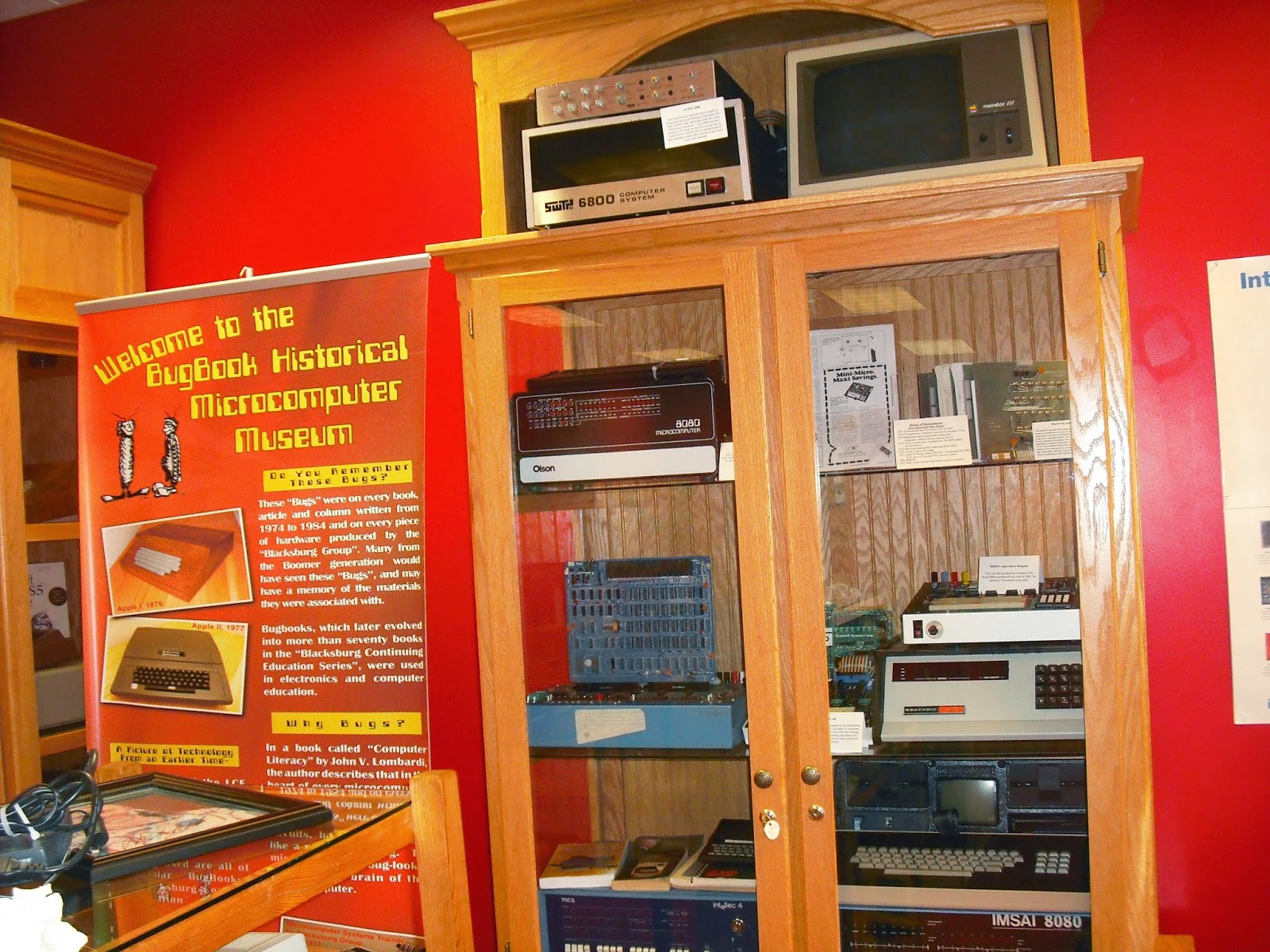
Computer Museum display


Story board welcome to the Bugbook Historical Microcomputer Museum


David Larsen
David Larsen in Museum


Curator David Larsen KK4WW working on displays


front of museum
front of museum


Front part of museum - The red walls and floor
are very Floyd looking. I like it .


Bugbook Computer Museum


back part of museum


Calculator Display
Calculator Display


Front corner - case with about 100 calculators in the background


Bugbook Museum
Bugbook Museum


Mr. Ed mounting wall displays


Bugbook Historical Microcomputer Museum


Bugbook Historical Microcomputer Museu
Bugbook Historical Microcomputer Museum


Our sign outside the entrance


Looking out the front door into parking lot and street.


Bugbook Historical Microcomputer Museum


Looking at building from the street - we have a nice parking lot just in front of museum.


Ham antenna
N4USA amateur radio antenna


 Antenna for our amateur radio station N4USA in the museum


David Larsen Museum Curator


 David at Amateur radio display info


David Larsen at N4USA


 David KK4WW at amateur radio station N4USA


David G Larsen
It has been a lot of fun and brings back memories from 50 years ago moving these computers and displays to the new area.
The museum and blog have given me the opportunity to hear from old friends and people who have used our books and teaching equipment from the 70s & 80s. Tonight I had a call from Maurice Green in Silicon Valley.  I lived in that area 51 years ago - wow that seems like times past. Maurice used our Bugbooks and Outboards in teaching digital electronics in the 80's and is still using them and teaching young folks about the basics of digital logic. He tells me they really enjoy this and he will report in the form of a blog to publish here on our site. I am looking forward to that information,