Showing posts with label blog. Show all posts

Wednesday, July 8, 2015

Discrete component electronics to Integrated Circuits - 50 years of change

Bugbooks
info click
A very short summary of the 50 years -  From individual transistors used to make electronic circuits in 1965 to one integrated circuit (smaller than your thumbnail)  microprocessor chip containing 5.5 billion transistors in 2015.
---------------------------------------------------------------------------------------------------

The Integrated Circuit (IC) changed electronics in a very big way.  Jack Kilby demonstrated a working example for the IC made of germanium  in 1958 and six months  later  Robert Noyce demonstrated his own idea of the IC made of silicon that  solved many practical problems of producing an IC. The invention of the IC was a new way of building electronic circuits and Jack Kilby received the Nobel Prize in physics  in December 2000. These notes from Wikipedia.

A lesson in electronic circuit manufacturing prior to the IC.
---------------------------------
click on photo to enlarge
7 transistor Radio 
Transistors were invented in 1947 and became a practical amplifier design element in about 1957.

Here is a look at the inside of a 1965 transistor radio made with 7 transistors.

 In 2007 one large memory IC contained a sufficient number of transistors to make more than one billion of these radios.


7 transistor Radio
Looking closer at the inside of the transistor radio you see the 2 black transistors with 3 legs and a few resistors, capacitors and inductors.  These are all discrete components.

These discrete components can be replaced by circuitry in a single IC - and by the billions in the one IC. An IC can have manufactured into the chip - diodes, resistors, capacitors, and transistors. However the chip count is always just the number of transistors. As of 2015, the highest transistor count in a commercially available CPU (in one IC chip) is over 5.5 billion transistors - Intel's 18-core Xeon Haswell-EP.

------------------------------

click on photo to enlarge
Computer museum
Vacuum tube amplifier
          Vacuum tubes were invented in 1904 by  John Ambrose Fleming and later individual transistors in 1947 invented by John Bardeen, Walter Brattain, and William Shockley are the amplifying element in all electronic circuits.
         This photo is an amplifier from an electronic instrument (Oscilloscope 1960) with about 36 tubes. The whole instrument had about 100 tubes. The amplifier is about 12 inchs by 12 inchs.
Transistors replaced vacuum tubes as amplifying devices in the 60's. Transistors are much smaller than vacuum tubes, use less power, generate less heat and in theory never wear out making circuits much smaller & use much less power.

computer museum
discrete components


The bottom of the amplifier containing all the needed resistors and capacitors needed to make the circuit operational.

This is called discrete component design because each part is a single  separate part - (resistor or capacitor in the design).


click on photo to enlarge
Bugbook Computer Museum
Components by Khrulev Alexey E.


Examples of discrete components.


Computer museum
resistors & capacitor - discrete components
Several discrete components in a circuit - resistors and capacitor wired together. The red device is the capacitor and is about 1/2 inch by 1/4 inch in size.

An IC smaller than the capacitor in 2005 contained more than a billion-transistors  on a single chip and in 2007  tens of billions of memory transistors on a single chip. I don't know what is available today, these numbers are just hard to imagine on a single chip.


------------------------------------------------
Click on photo to enlarge 
Computer Museum
IC chip containing millions of transistors
ICs have two main advantages over discrete circuits: cost and performance. Cost is low because the chips, with all their components, are printed as a unit by photolithography rather than being constructed one transistor at a time. Furthermore, packaged ICs use much less material than discrete 2, with up to 9 million transistors per mm2. Performance is high because the IC's components switch quickly and consume little power (compared to their discrete counterparts) as a result of the small size and close proximity of the components. As of 2012, typical chip areas range from a few square millimeters to around 450 mm.
----------------------------------------------------------------------
Bugbook computer museum
Carol Milazzio


Some nice photos taken in our museum by Carol Milazzio KP4MD during a recent visit - "Take a look Click"
----------------------------------------------------------------------


Bugbook Historical Microcomputer Museum
David Larsen
This blog post has been fun for me as a way to reminisce. I began to use vacuum tubes in 1952 as an amateur radio operator at 14 years old.  Later my teaching for 31 years at Virginia Tech started in 1967 with vacuum tubes and ended in 1998 using microcomputers. I experienced the whole range from tubes to large scale Integrated Circuits.
           ."by David Larsen"  KK4WW Computer Collector Historian 

Saturday, April 18, 2015

Vintage Computer - Datapoint 1100 - 8 bit computer

Bugbook Historical Microcomputer Museum
Datapoint 1100
Bugbook
Bugbooks
I received this Datapoint 1100 from the same person that provided the Datapoint 2200 terminal/computer and was told it was a prototype. I made some assumptions about this computer that were wrong and I also called it a 2100 in some of my information.  Gordon Peterson was kind to correct me on this and the Datapoint 1100 is a version of the 2200 without the tape storage drives in the case. It did have a storage drive but it was in a separate case or operating table. This is not a prototype but is a nice unit and I am glad to have it in my collection. Thank You - Gordon for getting me on board with the correct information.

I have made several post (listed below) here on my blog about the Datapoint 2200 and it is a very interesting story of perhaps the start of personal computers - long before MITS ALTAIR 8800, Apple , Microsoft or IBM.


To enlarge "CLICK" on photo
Bugbook Historical Microcomputer Museum
Datapoint 1100


This looks like a Datapoint 2200 without the cassette tape decks for mass storage.


Bugbook Historical Microcomputer Museum
Datapoint 1100


The inside looks very similar to the Datapoint 2200 without the 2 audio cassette drives for mass storage.


Bugbook Historical Microcomputer Museum
Datapoint 1100


This unit was tested April 1975.


Bugbook Historical Microcomputer Museum
Datapoint 1100


This name and serial number tag  indicates it is an 1100 and serial number #100.


Here is some great research about the first microprocessor - Ken Shirriff's Blog 


Older post about the Datapoint 2200:

Intel 8008 Microprocessor began as a 'Computer Terminal Corporation 2200" - an Electronic Data Terminal


"The Lost Story of the Texans Who Invented the Personal Computer Revolution"  a 327 page book by Lamont Wood & published in 2010.


                                                    Video about the Datapoint 1100
-------------------------------------------------------------------------------------------------------------
We always have interesting visitors in our Computer Museum with great stories about their experience with vintage computers - Here is a video with Virginia Tech Professor Bill Green. He makes some nice comments about our museum.  "CLICK TO VIEW"

David G Larsen
During the late 80's I was able to find  this fine Datapoint1100 & Datapoint 2200. They are both in the   "Bugbook Historical Microcomputer Collection".


Tuesday, October 21, 2014

Vintage Computer Rare SCELBI on display in "Bugbook Historical Microcomputer Museum"

The SCELBI 8B is a rare computer - according to the developer Nat Wadsworth only about 200 SCELBI computers were made in 1974/75.  One hundred of them were the 8B (Business Model).
Click on Photo to enlarge

bugbook Historical Microcomputer Museum
SCELBI 8B Microcomputer
Bugbooks
info click
Mike Willagel (on  his blog) indicated only about 12 original  models are know to be in museums. Mike estimates 20 to 40 originals still in collections and closets.  This SCELBI  has been in our collection 25 years and I purchased it from Robert Forman of Portland, Oregon. Robert purchased the bare boards and built the computer adding his own customs cards you see on the right side of the computer.

Mike Willagel has made clone cards for the SCELBI & some folks have made clone computers from the cards.


Go here for more information about the computer in this blog including a video with close up view of the cards & original purchase receipt   "CLICK".

   
          David give a little history about his SCELBI Microcomputer

Click on photo to enlarge 
bugbook Historical Microcomputer Museum
Display in museum with SCELBI  Microcomputer 
The SCELBI computer is on the second shelf down - right side, 

Computers in this display case top L-R Superjolt, LSI 11,the Tent card describing the SCELBI and copy of 1974 SCELBI advertisement.

2nd shelf Commodore 128 and SCELBI 8B.

Bottom shelf HP 85 microcomputer & Kaypro lugable computer.

On the top of case is a display of amateur radio publications.


bugbook Historical Microcomputer Museum
SCELBI computer information

Close up of tent card describing the SCELBI in display case and copy of  First SCELBI advertisement in 1974 OST amateur radio magazine. A copy of the 1974 QST is in our collection.

You can read the tent card information and see the advertisement
Click on the  photo to enlarge and read.


More Reference information about SCELBI Computers.

Mike Willegal's hobby Blog

Build Your Own SCELBI

John Calande - His SCELBI Clone
----------------------------------------------------------------------------------------------------------


bugbook Historical Microcomputer Museum
Bell & Howell Apple 2 computer

We have been busy today in the museum. Packed this Bell & Howell Apple 2 for shipment to "Alex's Apple Orchard" Museum collection.


It is not known how many of these computers are in collections however they are becoming rare and collectible.


bugbook Historical Microcomputer Museum
Bell & Howell Apple ll computer


When Steve Wozniak and Steve Jobs started to sell the Apple 2 computer - Jobs was not sure he could sell in the educational market and made a deal with Bell & Howell to sell to schools.   Jobs realized very soon he did not need  Bell & Howell and canceled the agreement.


David Larsen
We are having a good time with our "Bugbook Historical Microcomputer Museum" in Floyd, Virginia. Lots of visitors and nice to have Grayson a doing an Independent Study as graduate student from Virginia Tech (VT). Grayson is back September 2015 for one more "Special Study Course" at the museum. I taught about using early microcomputers at VT for 31 years and retired in 1998.


Monday, October 13, 2014

Vintage computers - "iWoz" Steve Wozniak's book by Wozniak & Smith - My comments - a good read

Bugbooks
info click
Anyone having an interest in the Apple Computer company and how it all started will really enjoy this book. Steve's book has been in print for 8 years - if you missed it now is a good time do your read. Their are many reasons for the tremendous success of Apple however it all started with Steve Wozniak
bugbook Historical Microcomputer Museum
Click image to enlarge
designing the Apple 1 microcomputer.  Their were many good breaks as the company developed and sometimes just being in the right place at the right time was a big help. Steve Jobs convinced Wozniak to sell his Apple 1 computer and was the marketing guru that made the company grow to what it is today and those first months of the start up are very interesting.

Did you know that the first partnership of the Apple company included 3 people not just the 2 Steve's. Ron Wayne was in on the  original official founding and actually is the one who wrote the partnership agreement and at that time owned 10 percent of the Apple company? Only 12 days after the partnership Ron dropped out and received about $800 for his interest. CNN story about Ron Wayne.

bugbook Historical Microcomputer Museum
Wozniak as Woz
Steve Wozniak ( Steve often goes by just Woz ) designed the Apple 1 and Apple ll totally on his own and also wrote the initial software monitor and Basic program.  Steve was and is a very smart and clever designer.  Woz wanted to give the plans of the Apple 1 for free and in fact did so at Homebrew Computer Club meetings. Of course without the Apple 1 their would be no Apple Company today.

The first sale made by Steve Jobs was just a few days after the original partnership was signed and he sold 50 Apple 1's to Paul Terrell owner of Byte Shop. It could be that without this sale their would be no Apple Computer Company today.


Bugbook Historical Microcomputer Museum, bugbook
Zaltair computer - steve wozniak
 "Zaltair Computer"      A really great practical joke that Steve Wozniak  pulled of at the First West Coast Computer Faire in April 1977.  Steve says in his book "iWoz" that he likes to do practical jokes and have someone else get blamed for doing the joke. In the case of the Zaltair he did a very good job and did not get accused of being the originator of the joke in fact Gary Ingram at Processor Technology was the one accursed of doing the hoax. The hoax was directed toward the Ed Roberts and his Mitts Altair 8800 microcomputer. Steve called his friend Adam Schoolsky to come help with this hoax.

More about the Zaltair.


   Woz with Apple 1
Photo by Dan Sokol
I recommend reading the book to learn in Woz's words about the start up of the Apple company and his own story. It is worth a second read if you like history and these fascinating story's told by Woz. The book "iWoz" published in 2006 and was on the New York Times best seller list.


David Larsen

I had the opportunity to read this book for a second time and I learned many new interesting story's  about Wozniak and the Apple Computer Company - a good read


Thursday, October 9, 2014

Vintage Computer - the first portable computer at 200 lbs - Autonetics Recomp 501 (1958)


                  Click photo to enlarge
Bugbooks
info click
Bugbook Historical Microcomputer Museum
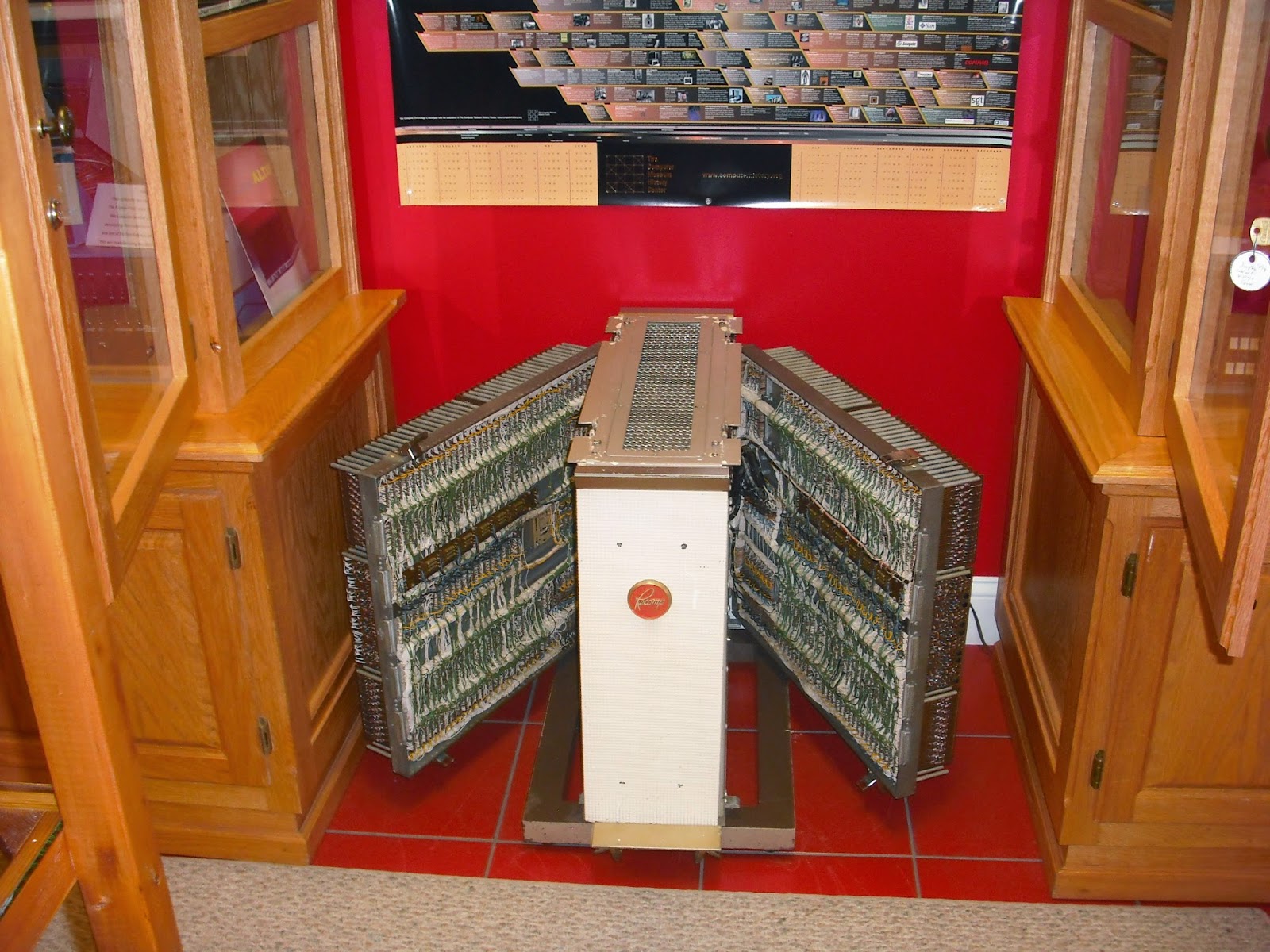
Autonetics Recomp 501 digital computer
The Autonetics Recomp 501 is also the very first commercial transistor digital computer. Autonetics computer is now displayed in our museum.  We moved the computer from the warehouse into the museum to help show the time line of computing before the microcomputer revolution.  This computer is serial # 003 & some components in it are date coded 1958 - this may be the earliest transistor digital computer in any a museum.  We are  delighted to have it -- WOW it is small but very heavy - about 200 lbs.

Autonetics Recomp 501 digital computer, bugbook
Autonetics Recomp computer in museum
The computer looks good with all the cards exposed - here it is in the museum.  The size is about 30 inch's high & 40 inch's in length.

It looks like a nice piece of art with all the cards, gold connectors and 1000's of wires connecting the cards.


    David tells about the Autonetics computer he acquired 25 years ago.                                                                                                                                                                                                                                                                                                                         Click on photo to enlarge
Bugbook Historical micrcomputer Museum
1958 ad for first 200 lb transistor computer
 This has to be the very first advertisement for a portable computer -about 1958. Look at the photo and see the two fellows carrying this 200 lb computer onto a construction site – WOW what a imagination. This computer is very heavy and these fellows are carrying it like it is only  30 lbs.
Here is some text from the advertisement.

200 lb computer – Portable Digital Computer that can solve your problems where they happen.

It may be a highway construction job --- oil exploration --- and aerial exploration. Where ever your problems happen – in the field – office – or lab.

-----------------------------------------------------------------------------------------------


Here is one side panel with the PC cards. It is built very solid and must have taken a very long time to build by hand.


David Larsen, kk4ww,bugbook, bugbook.com
Autonetics Recomp 501 digital computer


There must be at least 1000 wires in the backplane - all white. Building this computer required lots of Advil. This photo shows only a small part of the wiring.


David Larsen, kk4ww,bugbook, bugbook.com
Autonetics Recomp computer 


Drum memory - looks like the all the registers as well as the data are on this form of memory - ie Accumulator - the instructions were executed serially so this is a very slow computer. 


Autonetics Recomp 501 digital computer


Archive photograph - full operational setup.  This photo takes away the idea that this is a portable computer.

Here is link to another Autonetics computer that I worked on in 1960 and the Recomp computer supplied many ideas for this ICBM computer.


A good look at the RECOMP-11 photo album  "CLICK" 


---------------------------------------------------------------------------------------------------
A few references for the seriously interested - a service manual and more.

More photos and information about our Autonetics computer.

Recomp service manual - just in the event you have one and need to get it running.

This list claims the Recomp is the 118th type of digital computer every made
----------------------------------------------------------------------------------------------------

David Larsen
I have had this computer in my collection for 25 years or more and wish I had records of where it came from. I just remember it being in a corner with about 10 or so minicomputers. Most of the minicomputers have gone out to other collectors like Bob Rosenbloom 

Tuesday, October 7, 2014

Vintage Computer BBC Documentary "iWonder - History of Computing Timeline" using some Bugbook Computer Museum Video Clips

Bugbooks
info click
David Larsen & Apple 1
Several months ago I was contacted about using parts of my Apple 1 computer videos for the BBC program - "iWonder - History of Computing Timeline".  I don't know the schedule
of the program however I am delighted they chose to use some of my Apple 1 computer Video for the program.


Click on image to enlarge
Bugbook Historical Microcomputer Museum
BBC none exclusive use


Release and permission form to use our material. A simple use of our material however always nice to have some of the work done by our group used.


Earlier BBC documentary "Steve Jobs: Billion Dollar Hippy". BBC used some clips of my Apple one computer in this documentary as well at 11 minutes 50 seconds into the film. I watched this production again and noticed our group got a thank you in the credits as the LCF Group.

http://www.dailymotion.com/video/xn3fbz_steve-jobs-billion-dollar-hippy-2011-bbc_lifestyle&start=707

David Larsen


Saturday, October 4, 2014

Vintage Computer - Super Jolt a 1975 microcomputer using the 6502 Microcomputer


Bugbook Historical Microcomputer Museum
Super Jolt Computer
Bugbooks
info click
The Jolt computer used the 6502 microprocessor and was somewhat advanced in 1975. This is before the Apple 1 or Apple ll and the same year as the Altair 8800 microcomputer. The Altair 8800 sold for $395 in kit from with no software and a very small memory. The Jolt came with a monitor debugger program called Demon and had an interface for the Teletype (RS232 20 MA current loop). The wired unit sold for $348 and kit $249.  Accessory cards were also available like the 4kb RAM memory card for $320. However the computer never became very popular.


Here  is a video I made with Ray Holt telling his Jolt story. I made this at the Vintage Computer Festival SE 4.0 in April 2016.


Click on image to enlarge and read.
Bugbook Historical Microcomputer Museum
Jolt full page advertisement


The Jolt microcomputer was released in 1975 by Microcomputer Associates. The company was founded by Ray Holt and Manny Lemas.  The company was later acquired by Synertek, a second source manufacturer of the 6502, and renamed Synertek Systems. Synertek went on to produce the popular SYM-1 microcomputer. Ray Holt did some early microprocessor development work for use in the F-14 Tomcat aircraft.  This work was classified and Ray's design work during the period 1968 to 1970 may have been the very first microprocessor chip set .


Bugbook Historical Microcomputer Museum
Super Jolt Computer


The Super Jolt computer is on display in our "Bugbook Historical Microcomputer Museum"  located in Floyd , Virginia. The computer card is setting on top of original box from Jolt. I don't remember just when or who I received the computer from & the box also has a SYM-1 in it. Microcomputer Associates/Synertek produced these computers - this was a nice addition to our collection with 2 new and never used microcomputers.


Bugbook Historical Microcomputer Museum
Super Jolt Microcomputer CPU section


CPU section of the Super Jolt Microcomputer.


Bugbook Historical Microcomputer Museum
Memory Section - Super Jolt


The Super Jolt has more memory the the first Jolt.


David Larsen