Showing posts with label retro computer. Show all posts

Thursday, November 6, 2014

Vintage - Apple-1 Computer Clone operational at the "Bugbook Historical Microcomputer Museum"

Bugbooks
info click
-------------------------------------------------------------------------------------------------------
NEWS FLASH - Bob Luther is selling his "First Apple 1 Computer"  December 11,2014 at Christie's Auction.  Sold for $365,000
-------------------------------------------------------------------------------------------------------
Click on photos to enlarge
bugbook Historical Microcomputer museum
Apple 1 clone display 
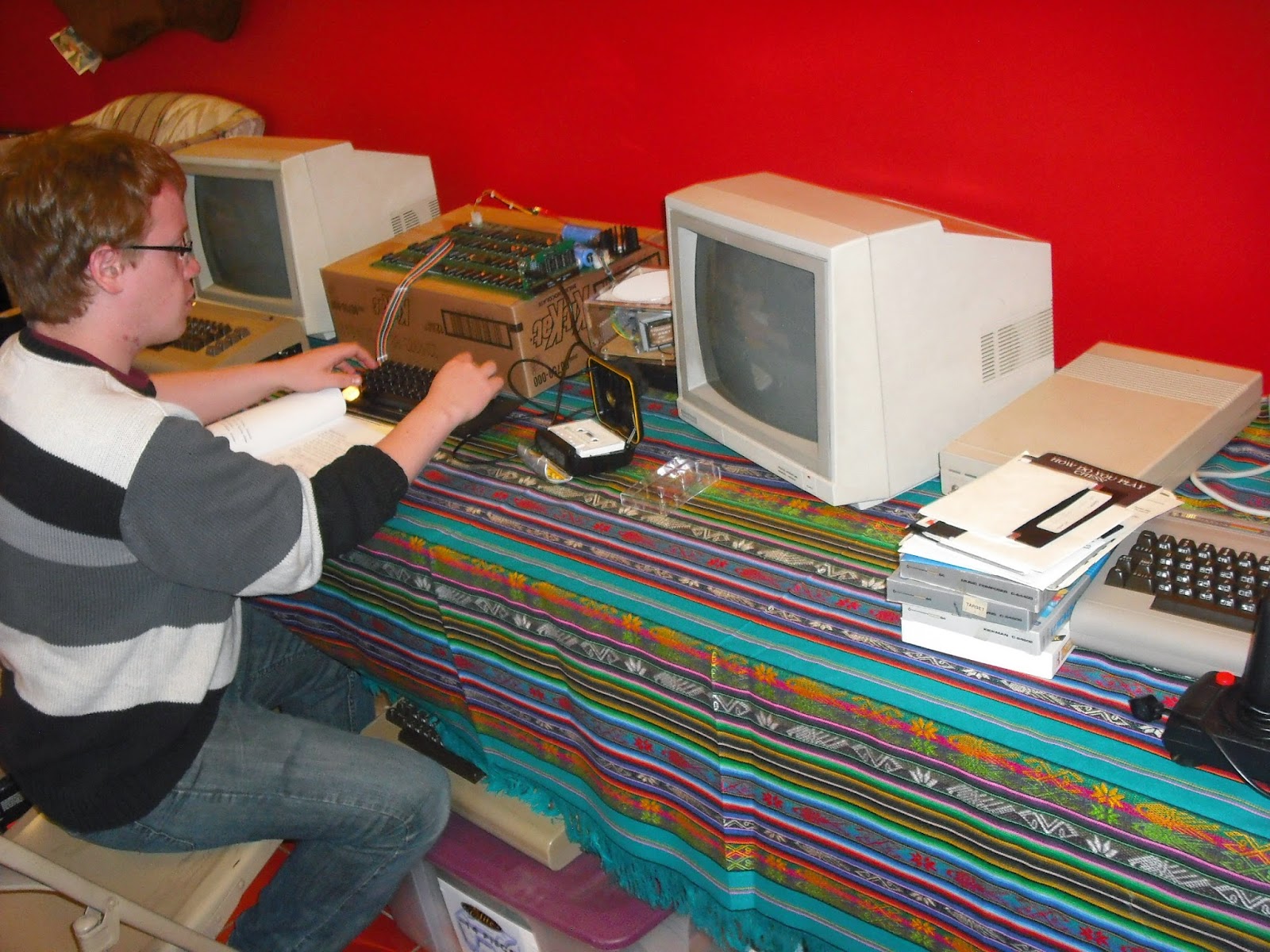
Apple-1 clone is operational and running programs just fine here in our museum. Grayson Van Beuren as part of his Graduate Independent Studies at Virginia Tech (VT) has been helping with interactive operational retro computers. This week the Apple 1 clone was tested and executes programs just fine. Grayson comes  to the museum every Friday for a several hours in the afternoon and we work together on projects for his studies. He is a very enthusiastic and a joy for me to spend time with in the museum. The museum is about a 50 minute drive from the VT campus and this study project takes up a lot of his Friday's.

Bugbook Historical Microcomputer Museum
Grayson Van Beuren

Grayson loading cassette Basic into the Apple-1. Basic loads fine using this old Walkman cassette player.


Grayson usually takes a vintage computer back to campus and works from home some Friday's. This is good use of his time and reduces his travel time to Floyd.


Bugbook Historical Microcomputer Museum
Running Apple 1 Basic 
The computer executes Basic just fine and is a popular display for our museum visitors.
Brandon Cholodenko assembled this Apple-1 clone for our museum by  starting with the Mimeo Apple-1 PC board from Mike Willegal. Brandon assembling of the Apple clone was great - it worked perfectly out of the box. 
This  Mimeo Apple-1 is just the ticket to get our original Apple-1 operational. The same power transformers and keyboard can be used operating the original Apple 1's.


                                              Operational Apple 1 Clone Computer

------------------------------------------------------------------------------------------------------------
It was a busy Friday for Gayson with a visit to the museum warehouse on the trip back to VT.

Bugbook Historical Microcomputer Museum
Grayson in Computer  Museum Warehouse

Grayson and a view inside the warehouse.  The warehouse contains 10,000 items  all entered on the professional museum software "Past Perfect". It has taken at least 5 years of intermittent work to get the inventory cataloged and entered into our collection database. The 10,000 items represent my 45 years of collecting and includes various computer memorabilia. I thank my summer student interns for entering most of data into "Past Perfect".


David Larsen, KK4WW
Grayson Van  Beuren & Apple Lisa computer
Grayson inspecting the Apple section of the warehouse looking at several Lisa computers.

The museum original Apple-1 computers are not in the warehouse. They are stored in the local commercial bank vault. I would not even trust having them at home. The house could burn down and they would be gone for good. The bank seems to be the best solution for storing safely.


Bugbook, Bugooks, Bugbook.com, Apple 1
Grayson Van Beuren with Core Memory
Grayson inspects a core memory stack.  This core 18 boards with 18 X 18 bit words. This is a total of 326 18 bit words of core memory. I really hugh box for so few words - yep really big cores. This demonstration memory module was donated to our museum by Dr. Thomas Haddock author of  "A Collector's Guide to Personal Computers and Pocket Calculators" you will find this book listed in our books for collectors.


David Larsen
The curators here at the museum always look forward to working with Grayson. We are all learning new things from this independent study project.


Friday, April 25, 2014

MITS Altair 680 Vintage Computer


Bugbook
Bugbooks
MITS Computers
MITS Logo 
The name MITS comes from the official company name "Micro Instrumentation & Telemetry Systems" --- way to long "MITS" is much better.  Ed Roberts the owner of MITS and was in business before the MITS 680 & 8800 microcomputers selling telemetry systems for model rocket folks and electronic calculator kits.

This MITS 680 is a real beauty - it was put to serious use by it's previous as you will see in the photos and video - with additional custom memory and some other interfaced hardware wired into the computer.

More info on the MITS company founded by Ed Roberts "CLICK"

Click on photo's to enlarge
Bugbook Computer Museum
MITS Altair 680 Microcomputer 

I placed the MIT 680 on top of it's big brother in the museum - they do go good together.

The computer was first announced  in the November 1975 issue of Popular Electronics and Shipped in 1976.

The price was $293 in kit or $420 wired ready to operate.


Here is a video tour of this MITS 680 'CLICK'

Bugbook Computer Museum
MITS Altair 680 Microcomputer


The basic computer is built around the 6800 microprocessor chip. The computer and memory are located on a single board. The wires and colored ribbon cable have been added by the builder and user of this MITS 680.


Bugbook Computer Museum
MITS Altair 680 Microcomputer

The computer came with 1K bytes of RAM memory and sockets for 1K of EPROM.

The builder of this computer built and added additional memory. The computer did not have any expansion possibility built in so the memory was attached to the top of the computer cabinet.


Bugbook Computer Museum
MITS Altair 680 Microcomputer


This was an early computer to be build using the 6800 microprocessor.  Two others were the SWTP 6800 and the Sphere.


Bugbook Computer Museum
MITS Altair 680 Microcomputer

The MITS 680 was to limited in function and it never was sold in large numbers.

The Apple ll came out in 1977  using the 6502 microprocessor and as a Plug and Play - ready to go out of the box and soon had the major market share for this kind of computer.


It has been a lot of fun and a good lesson for me to search our Bugbook Computer Museum warehouse and database for additions to our expanded museum display. I have so much accumulated over the 45 years of collection I could enjoy days of just roaming the storage shelves.  Sure I can search the database and I do sometimes to find out just where an item is located in the warehouse. That is nice as each of the 10,000 entries in the database also has information about just where it is located in the warehouse. A few things I learned today getting this MITS 680 - I found another PDP 8 minicomputer and teletype out of sight on the back of a shelf. I thought I had moved all the minicomputers on to new owners but not this one. Only a hoarder and collector like me would enjoy this kind of hunting.

bugbook historical Microcomputer Museum
David Larsen KK4WW

MITS was the first to offer a complete computer kit with cabinet and ready to operate with the MITS 8800 in 1975. The 8800 has a lot of history including the start of Microsoft with Bill Gates and Paul Allen writing a version of Basic for the 8800. Nice having these computer in our museum.

 "by David Larsen"  KK4WW Computer Collector Historian     Send Message    Like us on Facebook  My Blog about hometown Floyd VA

Thursday, March 13, 2014

Kevin Stumpf - his computer museum in waterloo

Bugbook
Bugbooks
Kevin -  I really enjoyed reading all the information and looking at the links.  It is sad for me that you had to give up the collection and museum idea.  I do fully understand that you gave it your best try and I can't even imagine the amount of time and work you put into this project.   

Thank you once again for your great work over the years working with historical computers and events.  Dave at the "Bugbook Historical Microcomputer Museum".

Kevin Stumpf tell us about his commitment to collect and preserve mainframes and mini computers for 17 years- This is a great story and you will enjoy his adventure.

Dave has collected computers much, much longer than I in fact I no longer collect nor do I have a collection any more, but between 1984 and 2001 I either found or was given, and then trucked and stored around 60 tons of computers, spares, supplies, accessories, and documentation. A brief list with links to photos of them is below.
I grew up with the “big boys” and so even though I found all sorts of either discreet-logic or micro-based desktops and portables, I very much enjoyed mainframes and minis if for no other reason than “real computers have control panels.” Besides, they gave me an excuse to drive big trucks too.
During this time there was a sense of urgency. Many collectors, myself included, believed that mainframes and minis and rare (read: unpopular or unsuccessful in the marketplace) micros were being scrapped at an alarming rate so it was up to us to ensure these artifacts would be around for future generations to study and enjoy. Now I believe we were a little over-enthusiastic. You probably won’t find as many ModComp’s as PDP-8’s, but many, many gems are still out there. Perhaps my sense of urgency is off kilter again, but I am sure there is still an IBM System/370 Model 165 with my name on it out there somewhere
IBM370

During the hay day some American collectors made odd comments about me due to my escapades up here in Ontario, Canada*. There was a rumour that I must be well-off to afford the expenses that were bound to accrue when handling such large items. Nothing could be farther from the truth. It was a labour of love and I had the backing of my family so sacrifices were willingly endured, but I rarely ever paid for these systems. That is because I was providing a service by removing the systems in exchange for them. The owners either had to pay someone or let this odd fellow (me) do it for free – we’d de-install, remove false flooring, cabling, docs, tapes, disk packs, furniture, everything!
Even though money wasn’t needed to buy anything, there were always expenses and then storage costs. eBay came to the rescue! There was always something extra or something that no longer “fit” the collection so it was sold to other collectors. Then towards the end of my collecting years I wrote A Guide to Collecting Computers and Computer Collectibles: History, Technique, and Practice (http://kevinstumpf.com/A_Guide_1998.htm ) and sold just enough copies each month to pay the rent.
Another silly comment I heard was something along the lines that “it was good that Canada still used so many old systems.” Give me a break. While such a comment is technically inaccurate it seems to be, at the very least, statistically impossible. If the market in the USofA is 10 times larger than that of Canada there should still be a slew of old mainframes below the 49th still ticking away or being cloistered until written off; many more than the Canadian market could support. Remember that /165 with my name on it? It will pop up in the USofA, not Canada.
While none of my acquisitions were easy to find, I would say I was blessed with resourcefulness. Instinctively the search for mainframes started with leasing companies who then introduced me to precious metal re-claimers**. The idea was that since leasing companies were responsible to dispose of the hardware when leases expired, they were a natural source to find out what would be available and when. While continuing to work with those sources I also held monthly chats with third party maintenance companies because the mainframes I was after were no longer supported by the manufacturers. Just imagine…perhaps the size of the collection would have been 200 tons instead of 60 if I had lived in southern California instead of an hour west of Toronto, eh. Just joking.
It distressed me to no end seeing dust accumulate on the collection. There it sat tucked away in a “ware”house. There had to be a reason for me gathering and preserving all this stuff. That’s when the idea for the Commercial Computing Museum – COMMPUTERSEUM – popped up. If you are interested in that part of this saga please visit (http://kevinstumpf.com/Account_of_COMMPUTERSEUM.htm ). The point I hope to make here now is that collections, I believe, should be active, not passive. It is incumbent upon collectors to try to put their collections to good use. There are activities you can do on your own. What I mean is that you can use your collection to educate and inform without working with or through clubs or volunteer-run museums. Indeed VCFs, open houses like those run by MARCH, and tours offered by the good folks at RICM, Bug Book Microcomputer Museum, and the Personal Computing Museum are good in themselves, but they are not the only venue from which you can help others enjoy vintage computing technology.
My collection has been used to fill retail windows in downtown stores or fill empty storefronts in malls. You are hard-pressed to find a shop or mall owner who doesn’t need and want help dressing vacant windows and storefronts. Another venue is schools. We took a DG Nova to high school electronics classes and called the class the School of Retrocomputing. We once collaborated with another local collector and ran a fund raiser for a downtown shelter by tidying the “ware”house and opening the doors to the public. It was rewarding to see how surprised and pleased each person was. Young and old saw things they would otherwise never see let alone be that close to.
Why not use your collection as props? You can also use your collection as the theme or backdrop to performance art, social comment vignettes (http://kevinstumpf.com/BatteryBasedLifestyle.htm ). The collection was also used as a “draw” at tradeshows. Organizers of local, regional, and national tradeshows gave us “guest booths”. Amidst all such serious endeavours don’t forget the goofy uses like computer arts and crafts (http://www.youtube.com/watch?v=RhfFN0W6hjE&feature=youtu.be ).
One of the coolest stories I “collected” involved a sculpture and the control panel from an IBM System/360 Model 65. I once tried to sell the control panel from a /65 on eBay. A professor from a local university was combing eBay looking for such an artifact so he called to ask if he could come over to, essentially, make a blueprint of the panel because he is also a sculptor and he wanted to make a metal sculpture of the panel. How cool is that? He also mentioned he hoped to also make one of the /40 panel so I was able to introduce him to the fellow who had purchased my /40 panel. The final results can be seen hanging in an exhibit travelling around the world (http://cgdy.com/?page_id=5&id_slideshow=29). Who knew.
Dave thank you for this opportunity. Peace everyone.
Kevin Stumpf
kevin@kevinstumpf.com
*Kitchener, Ontario to be precise. Kitchener is a twin city to Waterloo. Waterloo is the hometown of RIM, now called Blackberry. To learn more about my hometown please watch a presentation called A grassRoots History of the Early Hi-Tech Community in KW that was recorded at the Personal Computer Museum (http://kevinstumpf.com/grassRoots_intro.htm ). The Blackberry was created in KW for a reason. I wager that at one time in the late 1960’s Kitchener-Waterloo had the highest Instructions/Second/Capita in the world!
**I was always impressed by how well these fellows knew their mainframe model numbers
Partial list of machines that were in the collection…
A complete:
Most of an:
  • Amdahl 580 (5885 dual processor – the I/O controller “wings” were 2.5m/8’ long and weighed http://www.youtube.com/watch?v=lMIvmdLD5qg)
    Amdahl Logo
    Amdahl Logo
    998Kg /2200lb) (
  • IBM 4381 CPU (the tallest cabinet IBM ever made)
  • Burroughs B-80
  • DEC PDP-9
  • IBM System/38
  • IBM System/34 (which I grudgingly took because, you guessed it: no control panel!)

Univac Computer
Univac Computer
And control panels and consoles from all sorts of mainframes that I could have had, but at the time turned down (my bad), such as: Honeywell DPS-8, Honeywell Datanet-30, IBM 3705, Xerox Data Systems XDS-9, and UNIVAC 1108 and 418III. The console from the Confederation Life IBM 705, and also control panels that had already been stripped from the likes of an IBM System/360 Models 25, 30, 40, 65, and the beautiful 75, plus System/370 Models 148, 165, and 168, and then small ones from peripherals and minis. Also ADP equipment such as IBM card sorters and all sorts of keypunches. Additionally we had supporting material such as the complete library of the Auerbach Computer Reports (publisher’s copy). Plus machines like the venerable Xerox Star, portables such as the IBM 5100 and DG/One, a smattering of early handhelds like a Workslate, strange boxes like Keronix and Hyperion, a mandatory Altair, early micros, and things called Macs  By Kevin Stumpf

David G Larsen
David G Larsen
Bugbook Historical Microcomputer Museum
A start on the move to new location
We have been in our new location in the front of the Village Green in Floyd Virginia for about 5 days now and the displays are starting to look good.  A few more days and we will be set up with the old and then bringing in more vintage computers.  It is a lot of work but fun.

"by David Larsen"  KK4WW Computer Collector Historian   
  Send Message    Like us on Facebook  My Blog about hometown Floyd VA

Sunday, March 9, 2014

Vintage Computer -MITS Altair 8800 restored by Josh Bensadon


Popular Electronics,January 1975
Bugbook
Bugbooks
Another ALTAIR 8800 is working once again.  This system was bought from David Larsen in August of 2013.  When I first saw it, immediately, my curiosity and imagination began to ponder what kind of service did this machine provide.  Some of the labels were worn out, so that speaks of a lot of switch use.  However, the switches themselves did not look worse for wear, so I'm guessing this system was used by one person that was careful to not damage switches over time.  Normally, the display LED's and Switches are grouped in sets of 3 to facilitate the octal numbering system.  This numbering system fits well with the 8080 instruction set and was used in many of the mini computers that came before the ALTAIR.  Interestingly enough, this system had the Switches and LED's grouped in sets of 4 for the hexadecimal system.  This might have been done because the CPU card that came with it was a Z80 CPU, but I am just guessing here.

Of course, the system was not operational when it got on my bench.  This is a good thing, since it meant I would have to open it up and learn more about it.  Before I go any further, the one thing I found to be very odd about the ALTAIR is the direction of the Power Switch.  Down is ON?  That was a very European thing, but I don't know a whole lot about Ed Roberts history.The problems were found quickly and without getting into trouble shooting, I'll just say the Bridge Rectifier had a bad connection and the 7430 chip that put the CPU into wait state was not working.  About 12 months earlier, I fixed up an IMSAI 8080 system which
IMSAI 8080
IMSAI 8080
was told to be a copy of the ALTAIR BUS, but what I didn't realize was how much of a copy it really was.  While studying the schematics to trouble shoot, I could see the IMSAI front panel design as practically a chip for chip copy.  The ALTAIR 8800 was brought out to market as a construction article in Popular Electronics, Jan 1975.  This article was driven as a response to the competition's magazine (Radio Electronics) article to build the MARK-8, which came out 6 months earlier in July 1974.  But what made this computer more significant was how others like the IMSAI 8080 copied it.  They say imitation is the sincerest form of flattery.  By copying it, they claimed the bus structure was a standard that everyone could build to, and people did.  I recall reading PE and RE magazines and everyone was either operating an S-100 bus or they provided a module to interface to it.  Well, I must bring this blurb to a close, but before I do, I would like to say as a Popular and Radio Electronics collector and enthusiast, this now working ALTAIR 8800 is the center piece of my collection.  Thank you David.

Regards,
Josh Bensadon

Josh Bensadon his "MITS 680"  "IMSAI 8080"
Josh Bensadon his MITS 8800,680  & IMSAI 8080 


David G Larsen
David G Larsen
 I am delighted to see Josh has this MITS Altair microcomputer operational again. It had been in the Bugbook Historical Microcomputer Museum warehouse for at least 25 years.

"by David Larsen"  KK4WW Computer Collector Historian   
  Send Message    Like us on Facebook  My Blog about hometown Floyd VA

Wednesday, January 1, 2014

Vintage Computer Volksmodem 70's 300 baud modem

Bugbooks David Larsen KK4WW
Bugbooks
Volksmodem
Volksmodem
I found this vintage Volksmodem while searching for some papers in the "Bugbook Historical Microcomputer Museum" warehouse. It is new and never been out of the box until now.  It is a good example of an early low priced modem.

Here is a video of the Volksmodem 'CLICK'
    
 'The Universal Interface for Computer Communications by  Telephone'
  • Connects directly to a wall jack
  • Telephone receiver jack with Voice/Data
  • 300 baud ( bits per second )
  • Bell 103 compatible
  • Originate/answer mode automatically selected
  • Battery powered, low drain for long life ( batteries not included )Made in USA
Manufactured by Anchor Automation,6913 Valjean  Avenue, Van Nuys, California 91406
Enlarge the photo's by clicking on them and then even more by a right click and select "View image' you can easily read the text
Volksmodem
Back of Box 


To interconnect the Volksmodem you need appropriate cable, computer, telephone, appropriate software and in some cases a serial communications port or card.


Volksmodem modem
one sided circuit board
Volksmodem modem
Volksmodem Specifications 300 baud

 The instructions and manual are so simple. This should be easy to use.


Ruth a Larsen
That's me David at age 5 1943
WOW  Here I am with my mother Ruth and dad William in 1943. I was 5 years old .  Five years later I had a crystal radio and that started my life long interest in electronics. I received my amateur radio call license( W7VZW now KK4WW ) in 1954 at age 15. I have said may times my folks were old time farm people. They did have a car here but early in their marriage they used a horse and buggy. I have great pictures of their early days -- really interesting.
"by David Larsen"  KK4WW Computer Collector Historian   
   Send Message CLICK   Like us Click

Wednesday, December 25, 2013

Vintage Computers - The "Bugs" are 40 years old !

Bugbook David larsen
8080 Bugbook 
Bugbooks Bugbook
Bugbooks
integrated Circuit Bug
Integrated Circuit looks like a Bug 

When Bugbooks 1 & 2 were written a logo was needed for the books and other projects. The books were written to teach basic digital electronics using small Scale Integrated Circuits.  I named the books bugbooks because the small digital integrated circuit looked like a bug with its legs. I had made several attempts at a logo however they were not very inspiring. The best I can remember Professor Peter Rony ask students to submit their ideas for a logo and  this one was selected.  I have been very pleased with this logo and it has made many millions of impressions during the past 40 years. The 'Bugs' logo has been great as a branding image for the work of my colleagues and myself.


Here are a few examples of the Bugs use during the past 40 years.
Enlarge the photo's by clicking on them and then even more by a right click and select "View image' you can easily read the text.
John Titus
Code card 1978 

John Titus designed this very useful octal code card for 8080 microprocessor machine code programming in 1978.


David larsen
Japanese translation
 of Bugbook 2


Japanese translation of Bugbook 2 in 1976. The Bugs logo is prominent on the front cover. Several of the Bugbooks were included in these translations.


David Larsen
Italian Bugbooks


An advertising button used by our Italian representative.  Our group had a large presence in Italy during the late 70's and early 80's. About 20 of our Bugbooks were translated into Italian,  we taught 15 or so microcomputer instrumentation seminars, and a lot of the MMD-1 training computers were sold.


Fist Fighter code fixer
Fist Fighter code fixer 
Our group was called "The Blackburg Group" and the Bugbooks was one of the group's many ideas and projects. Here is a product Dr. John Titus designed for the amateur radio market. This was called the fist fighter and it made perfect code out of code sent manually with a telegraph key. A very clever idea but it was not a popular product.  It did use the 'Bugs Logo' as you can see in an expanded photo.


More information about the name and use of the 'Bugs' & 'Bugbooks'

The reason I call our museum  "The Bugbook Historical Microcomputer Museum"  is because of the "Bugbooks"
David Larsen KK4WW
Bugs Logo 
. About 1974 I was part of a team that produced these books. The first two Bugbooks were written and published by Professor Rony and I.  I named the books bugbooks because the small digital integrated circuit looked like a bug with its legs.  Professor Rony typed the manuscripts and we self published the first few printings of the "Bugbooks" . 
www.bugbookcomputermuseum.com  These books were the start of a book series called "The Blacksburg Continuing Education Series" .  The books covered various topics of digital electronics, computers and software. Dr. John Titus and Dr. Chris Titus joined the group and became important members of our team.  During the period 1974 to 1984 about 75 books were published with a circulation of over 1 million copies.  Our team hired 31 other authors to help write books in the series. In addition to the books our team designed several computers and other teaching / engineering aids that were sold world wide. John Titus was the computer designer and I designed the digital engineering  / teaching hardware aids.  Many engineers, technicians and  electronic hobbyist of the late 70's and 80s used  these books and hardware.  All the books and hardware are on display in our museum. A reoccurring comment from  folks visiting the museum is - I  learned digital electronics from the "Bugbooks". The Bugbook story involves many relationships, interesting events and eclectic people.  It is my  intent to get the details of these adventures in writing -- soon I hope.


KK4WW
David Larsen 
It has been an interesting 40 years.  I am still getting calls about the Bugbooks and other computer and electronic things. Just tonight a fellow here in Floyd called and was in need of a 10 ohm resistor. He could not find a shop in the area that sold these parts.  I was able to find one in my old junk pile and will deliver it to him tomorrow.  He needed it for his computer power supply - Still doing computer projects.
WOW just as I posted this I received an email from Earles L. McCaul the author of   TRS-80 ASSEMBLY LANGUAGE MADE SIMPLE.  This is one of the books in our "Blacksburg" series of books from 1981.

  "by David Larsen"  KK4WW Computer Collector Historian   
   Send Message CLICK   Like us Click