Showing posts with label Minicomputer. Show all posts

Sunday, February 1, 2015

Computer Museum - Curator of Telephone Museum Curtis Anderson visits

Click on photo's to enlarge 
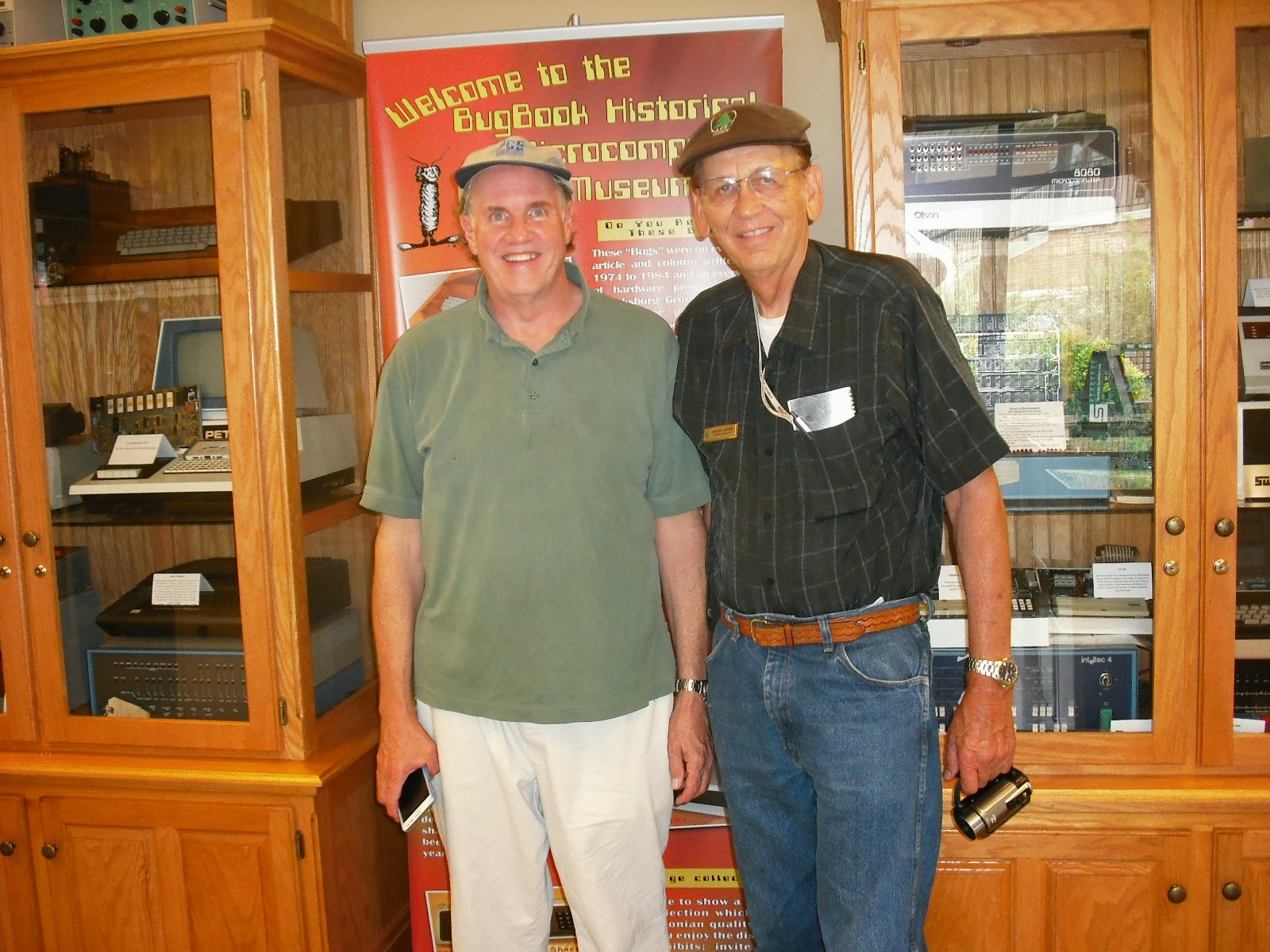
L-R David Larsen KK4WW, Curtis Anderson N4ON
Bugbooks
info click
Curtis Anderson N4ON curator of the Telephone Museum in Richmond Virginia made his second visit to our musuem.  We had a great time talking about the vintage computers and sharing stories of our collecting. Curtis made a video of the museum displays and we will post it when available. We made   plans for Curtis to join our display of vintage computers at Frostfest in Richmond Va on February 7th 2015. I invite you to come take a look at the fest.


Crutis inspecting Osborne computer
This display has some great vintage computers, MARK-8,Intellect-4,Heathkit H-8, MMD-1,Byteshop,Sinclair, Osborne, Intel 1972 Development system and more. Listen to the link below for me giving a tour of this display.


Audio description of computers in this cabinet "CLICK"


Autonetics 1958 transistor computer
Oldest Transistor computer in the world

This computer is the 1958 Autonetics Recomp 2 serial number 003 - perhaps the very oldest transistor computer in the world.  I worked the Summer of 1960 at Autonetics on the Minute Man 1 ICBM computer -  what an experience 55 years ago - Golly I must be getting older that was a long time ago.


experiment wireless transmitter 1916
1916 " How to build your own Spark Gap Transmitter

This is very old 1916 - how to build your own wireless transceiver. Curtis brought this for me to look over. It is how to build your very own Spark Gap transmitter and reciever --- & you don't need a license to operate ( that was operate in 1916 of course).

I will try to publish the whole manuscript here in the future.


PDP- 10 Digital Equipment Corporation
PDP-11/10
I have only one minicomputer in the museum - this gives me a way to compare the old mini's to microcomputers. I had a good number of minicomputers in the museum warehouse but have passed most of them on to other collectors and museums. Give a listen to my description just below.

Audio discussion about this PDP-10 "CLICK" 


Amateur Radio Station N4USA in museum


Amateur Radio station N4USA is operational with beam antenna on the roof. The station works good from museum. Curtis and I also made some radio contact from N4USA at Chantilly Farm.


More info about N4USA  in the museum "CLICK"


During Curtis's visit we had a good time making audio recordings & videos about historic events. A sample is below. Good stuff for history buffs.
------------------------------------------------------------------------------------------------------
Curtis is curator of the Telephone Museum in Richmond VA and below tells a few short stories about Alexander Bell and the invention of the telephone.


 Bell invents the telephone on way to making hearing device for hard of hearing.


  Bell get telephone patent ahead of other inventor by chance.


  Alexander Bell demonstrates wireless transmission of voice 4 years after inventing the telephone.

A short video of history from the Transistor to the Microcomputer by Curtis N4ON
-----------------------------------------------------------------------------------------------------

Bugbook Historical Microcomputer Museum
David Larsen
Thank you for the visit Curtis - it was fun to talk about vintage computers and old times during our careers 30 or more years ago.

           ."by David Larsen"  KK4WW Computer Collector Historian 


Sunday, September 28, 2014

PDP11/10 Vintage Minicomputer in Bugbook Historical Micrcomputer Museum

Our museum has only one minicomputer - (PDP11/10)   on display. We think it is a good idea to have a minicomputer to make comparisons with the microcomputers.  This PDP11 was  made
Bugbook Historical Microcomputer Museum
PDP11 computer
Bugbooks
info click
in 1971 and cost about as much as a small house. It is easy to see why not many people could afford to purchase a minicomputer for home use. When the first microcomputers became available they were instantly in demand. The Altair 8800 first microcomputer kit made possible home computing  in January of 1975. The Altair 8800 sold for $395 however it was very limited in capability without a lot of skilled work and additions to the computer. The Altair was designed by Ed Roberts. Ed thought he could sell 500 computers however I understand he had 4000 orders the first several months. We are fortunate to have one of the very first Altair 8800's in our collection -- Serial Number 23.


 The PDP 11/10 in the Bugbook Historical Microcomputer Museum by David Larsen


Click photo to enlarge
Bugbook Historical Microcomputer Museum
PDP11 and David Larsen, Curator with PDP11

Digital Epuipment Corporation (DEC) made mincomputer from 1960 to about 1990. Microcomputers put DEC out of business with very good low cost computing. The first PDP computer was a PDP1 in 1960. Only about 3 of these computers still survive. The Computer History Museum in Mt. View, California has a restored PDP1 restored and in nice working condition.


Bugbook Historical Microcomputer Museum
PDP11/10 minicomputer


Many versions of the PDP11 were made and about 600,000 were sold during its 20 year lifetime.


Bugbook Historical Microcomputer Museum


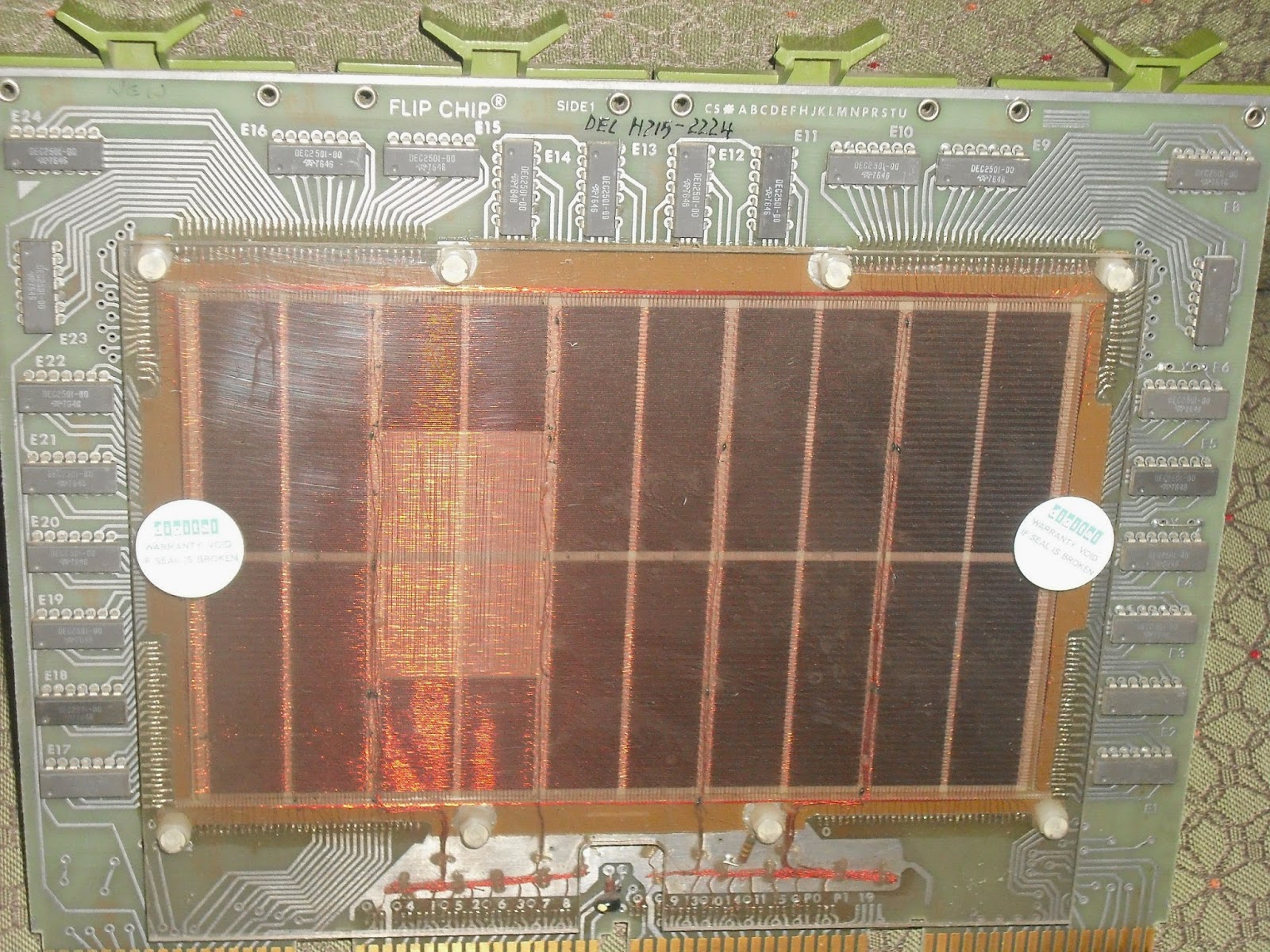
The core memory is nonvolatile and does not lose its memory when powered off for the day. This module has very tiny cores -probably  16k words of 16 bits each.


Magnetic core memory module PDP11/10

Click this link for a verbal description.The PDP 11/10 

David Larsen


Thursday, March 13, 2014

Kevin Stumpf - his computer museum in waterloo

Bugbook
Bugbooks
Kevin -  I really enjoyed reading all the information and looking at the links.  It is sad for me that you had to give up the collection and museum idea.  I do fully understand that you gave it your best try and I can't even imagine the amount of time and work you put into this project.   

Thank you once again for your great work over the years working with historical computers and events.  Dave at the "Bugbook Historical Microcomputer Museum".

Kevin Stumpf tell us about his commitment to collect and preserve mainframes and mini computers for 17 years- This is a great story and you will enjoy his adventure.

Dave has collected computers much, much longer than I in fact I no longer collect nor do I have a collection any more, but between 1984 and 2001 I either found or was given, and then trucked and stored around 60 tons of computers, spares, supplies, accessories, and documentation. A brief list with links to photos of them is below.
I grew up with the “big boys” and so even though I found all sorts of either discreet-logic or micro-based desktops and portables, I very much enjoyed mainframes and minis if for no other reason than “real computers have control panels.” Besides, they gave me an excuse to drive big trucks too.
During this time there was a sense of urgency. Many collectors, myself included, believed that mainframes and minis and rare (read: unpopular or unsuccessful in the marketplace) micros were being scrapped at an alarming rate so it was up to us to ensure these artifacts would be around for future generations to study and enjoy. Now I believe we were a little over-enthusiastic. You probably won’t find as many ModComp’s as PDP-8’s, but many, many gems are still out there. Perhaps my sense of urgency is off kilter again, but I am sure there is still an IBM System/370 Model 165 with my name on it out there somewhere
IBM370

During the hay day some American collectors made odd comments about me due to my escapades up here in Ontario, Canada*. There was a rumour that I must be well-off to afford the expenses that were bound to accrue when handling such large items. Nothing could be farther from the truth. It was a labour of love and I had the backing of my family so sacrifices were willingly endured, but I rarely ever paid for these systems. That is because I was providing a service by removing the systems in exchange for them. The owners either had to pay someone or let this odd fellow (me) do it for free – we’d de-install, remove false flooring, cabling, docs, tapes, disk packs, furniture, everything!
Even though money wasn’t needed to buy anything, there were always expenses and then storage costs. eBay came to the rescue! There was always something extra or something that no longer “fit” the collection so it was sold to other collectors. Then towards the end of my collecting years I wrote A Guide to Collecting Computers and Computer Collectibles: History, Technique, and Practice (http://kevinstumpf.com/A_Guide_1998.htm ) and sold just enough copies each month to pay the rent.
Another silly comment I heard was something along the lines that “it was good that Canada still used so many old systems.” Give me a break. While such a comment is technically inaccurate it seems to be, at the very least, statistically impossible. If the market in the USofA is 10 times larger than that of Canada there should still be a slew of old mainframes below the 49th still ticking away or being cloistered until written off; many more than the Canadian market could support. Remember that /165 with my name on it? It will pop up in the USofA, not Canada.
While none of my acquisitions were easy to find, I would say I was blessed with resourcefulness. Instinctively the search for mainframes started with leasing companies who then introduced me to precious metal re-claimers**. The idea was that since leasing companies were responsible to dispose of the hardware when leases expired, they were a natural source to find out what would be available and when. While continuing to work with those sources I also held monthly chats with third party maintenance companies because the mainframes I was after were no longer supported by the manufacturers. Just imagine…perhaps the size of the collection would have been 200 tons instead of 60 if I had lived in southern California instead of an hour west of Toronto, eh. Just joking.
It distressed me to no end seeing dust accumulate on the collection. There it sat tucked away in a “ware”house. There had to be a reason for me gathering and preserving all this stuff. That’s when the idea for the Commercial Computing Museum – COMMPUTERSEUM – popped up. If you are interested in that part of this saga please visit (http://kevinstumpf.com/Account_of_COMMPUTERSEUM.htm ). The point I hope to make here now is that collections, I believe, should be active, not passive. It is incumbent upon collectors to try to put their collections to good use. There are activities you can do on your own. What I mean is that you can use your collection to educate and inform without working with or through clubs or volunteer-run museums. Indeed VCFs, open houses like those run by MARCH, and tours offered by the good folks at RICM, Bug Book Microcomputer Museum, and the Personal Computing Museum are good in themselves, but they are not the only venue from which you can help others enjoy vintage computing technology.
My collection has been used to fill retail windows in downtown stores or fill empty storefronts in malls. You are hard-pressed to find a shop or mall owner who doesn’t need and want help dressing vacant windows and storefronts. Another venue is schools. We took a DG Nova to high school electronics classes and called the class the School of Retrocomputing. We once collaborated with another local collector and ran a fund raiser for a downtown shelter by tidying the “ware”house and opening the doors to the public. It was rewarding to see how surprised and pleased each person was. Young and old saw things they would otherwise never see let alone be that close to.
Why not use your collection as props? You can also use your collection as the theme or backdrop to performance art, social comment vignettes (http://kevinstumpf.com/BatteryBasedLifestyle.htm ). The collection was also used as a “draw” at tradeshows. Organizers of local, regional, and national tradeshows gave us “guest booths”. Amidst all such serious endeavours don’t forget the goofy uses like computer arts and crafts (http://www.youtube.com/watch?v=RhfFN0W6hjE&feature=youtu.be ).
One of the coolest stories I “collected” involved a sculpture and the control panel from an IBM System/360 Model 65. I once tried to sell the control panel from a /65 on eBay. A professor from a local university was combing eBay looking for such an artifact so he called to ask if he could come over to, essentially, make a blueprint of the panel because he is also a sculptor and he wanted to make a metal sculpture of the panel. How cool is that? He also mentioned he hoped to also make one of the /40 panel so I was able to introduce him to the fellow who had purchased my /40 panel. The final results can be seen hanging in an exhibit travelling around the world (http://cgdy.com/?page_id=5&id_slideshow=29). Who knew.
Dave thank you for this opportunity. Peace everyone.
Kevin Stumpf
kevin@kevinstumpf.com
*Kitchener, Ontario to be precise. Kitchener is a twin city to Waterloo. Waterloo is the hometown of RIM, now called Blackberry. To learn more about my hometown please watch a presentation called A grassRoots History of the Early Hi-Tech Community in KW that was recorded at the Personal Computer Museum (http://kevinstumpf.com/grassRoots_intro.htm ). The Blackberry was created in KW for a reason. I wager that at one time in the late 1960’s Kitchener-Waterloo had the highest Instructions/Second/Capita in the world!
**I was always impressed by how well these fellows knew their mainframe model numbers
Partial list of machines that were in the collection…
A complete:
Most of an:
  • Amdahl 580 (5885 dual processor – the I/O controller “wings” were 2.5m/8’ long and weighed http://www.youtube.com/watch?v=lMIvmdLD5qg)
    Amdahl Logo
    Amdahl Logo
    998Kg /2200lb) (
  • IBM 4381 CPU (the tallest cabinet IBM ever made)
  • Burroughs B-80
  • DEC PDP-9
  • IBM System/38
  • IBM System/34 (which I grudgingly took because, you guessed it: no control panel!)

Univac Computer
Univac Computer
And control panels and consoles from all sorts of mainframes that I could have had, but at the time turned down (my bad), such as: Honeywell DPS-8, Honeywell Datanet-30, IBM 3705, Xerox Data Systems XDS-9, and UNIVAC 1108 and 418III. The console from the Confederation Life IBM 705, and also control panels that had already been stripped from the likes of an IBM System/360 Models 25, 30, 40, 65, and the beautiful 75, plus System/370 Models 148, 165, and 168, and then small ones from peripherals and minis. Also ADP equipment such as IBM card sorters and all sorts of keypunches. Additionally we had supporting material such as the complete library of the Auerbach Computer Reports (publisher’s copy). Plus machines like the venerable Xerox Star, portables such as the IBM 5100 and DG/One, a smattering of early handhelds like a Workslate, strange boxes like Keronix and Hyperion, a mandatory Altair, early micros, and things called Macs  By Kevin Stumpf

David G Larsen
David G Larsen
Bugbook Historical Microcomputer Museum
A start on the move to new location
We have been in our new location in the front of the Village Green in Floyd Virginia for about 5 days now and the displays are starting to look good.  A few more days and we will be set up with the old and then bringing in more vintage computers.  It is a lot of work but fun.

"by David Larsen"  KK4WW Computer Collector Historian   
  Send Message    Like us on Facebook  My Blog about hometown Floyd VA

Thursday, December 19, 2013

Vintage Computers -First PDP computers from Digital Equipment Corporation early 1960's


 Lyle Bickley tell story of how Digital Equipment Corporation (DEC) started to make their first Minicomputers.

Digital Equipment Corporation DEC
DEC
Bugbooks
Bugbooks
How and why Digital Equipment Corporation (DEC) started to make minicomputer in the early 1960's. DEC was already making digital modules for science and industrial use. These consisted of the usual AND , OR , NOR, NAND , NOT gates and various filp-flops. Other special modules were made for instrumentation as well. 

Having all this digital capability DEC engineers wanted to use the modules to make a computer. Management resisted this for fear of competition from big Blue (IBM).  Management finally gave in however the computer could not be called a computer it was called a "Programed Data Processor" or just PDP.  The first was the PDP1 soon followed by the PDP8. Folks began calling them minicomputers.

These early PDP computers  are in great demand by collectors however it is believed only 3 PDP1's still exist and the only one operational is at the Computer History Museum in Mountain View, California.  Later models are available but the very early ones - PDP8, PDP8S are difficult for collectors and computer retro  folks to find. I was very fortunate to have acquired several original PDP8, PDP8S and PDP11/70 computers. My interest is more with historical microcomputers. The PDP minicomputers in the "Bugbook Historical Microcomputer Museum" have now been pasted on to other retro collectors of minicomputers. You will some of my past blog posting about these transfers/collectors.

PDP1 Minicomputer
PDP1 Minicomputer 
Photo of DEC PDP1 minicomputer at the Computer History Museum in Mountain View, California.  Lyle Bickley (seated at the control panel) is on the PDP1 restoration team at the museum.  This is the only operational PDP1 in the world.

Video of the PDP1 restoration story by Lyle Bickley 'CLICK'

Photo L-R My wife Gaynell Larsen - Bob  Rosenbloom and Lyle Bickley. This visit was in October 2013.


KK4WW
David Larsen
Thank you Lyle Bickley for allowing me to make this audio story and publishing it on my blog post.  The recording was made while touring the Computer History Museum in Mountain View, California --- lots of background noise however I found the story very interesting and I hope you do as well . Thank you for taking a look - listen.

 "by David Larsen"  KK4WW Computer Collector Historian   
   Send Message CLICK   Like us Click


Thursday, November 28, 2013

Vintage Computers or life as CIA Secret Agent for 50 years.

Oregon state university
OSU
bugbooks
info click
Graduating from Oregon State University OSU 67 years ago in 1963 I had a choice of  public profession / avocation in computers, ham radio, 1000's of fun experiences or the Secret Life of a CIA operative.            Send me A Message CLICK 
Post Updated 9/10/2020

Friends reading my blog know that I choose the public path and GOLLY WHIZ it has been a great 67 years ( 82th Birthday this year 2020) . The 67 years included family, electronics, computers & ham radio.
Central Intelligence Agency
CIA
My Central Intelligence Agency (CIA)  adventure began in February 1963 with interview on the OSU  campus by mysterious fellows interested in  my Navy background and technical education. 


Enlarge the photo's by clicking on them and then even more by a right click and select "View image' you can easily read the letters.
CIA Letter
Letter come for CIA testing

I received this letter inviting me to CIA  Headquarters in McLean, Virginia to test my physical health and emotional stability.  This was exciting for me at the time because this would be my first time for a cross county jet plane flight and first time to Washington DC.  I made the flight just fine and the drive from Baltimore Washington International Airport though the Maryland country side was beautiful.

The testing was a marathon of many Psychoanalyst type folks interviewing me and repetitive Polygraph testing.  This testing went on for two days and I was ready to get back home to Oregon.


All the time at CIA Headquarters I was asking - What will I be doing or what is the work be all about ? Their were very few answers and about the most I was able to find out was that I would most likely be working as a military person and wearing commissioned officers uniform most of the time. This also would require being attached somewhere to a military "Embassy or Base" post-  somewhere? - anywhere was a better description. WOW this was getting interesting I could impersonate a military officer.  As to what I would do -- I was not told much but it would be something to do with electronics - maybe tapping phones lines, bugging someone or someplace. 

I returned to OSU - graduated, moved to Palo Alto, California, had a nice job as engineer at an electronics company, moved into a house, set up my ham radio station and was settled in for a career in Electronics.------------------------

CIA Telegram
Telegram - Come to work CIA
Then another clandestine communication  in the form of the Western Union Telegram from  unknown person asking  me to call 351-1100 collect and ask for Miss Giuliani.  When I reached this lady I was put thought to a voice telling I could report to CIA Headquarters for training and assignment.

About the only indication I had that the CIA may be interested after my trip to CIA Headquarters was that all my neighbors around  home had been contacted by FBI agents. The agents were asking a lot questions about my character and was I a good guy. This did concern my parents as they were just old time farm folks and this CIA stuff was beyond their imagination. 

                                                                                                                                                                  
CIA letter
Nice CIA response to Dave
I was really settled into my new environment and work as engineer in the early days of Silicon Valley and a move to somewhere unknown just did not appeal to me.  I responded to Mr. E. D. Echols with a thank you for all the effort  to make sure I was physical healthy, emotionally stable and the FBI checkout . I was just not interested at this time and turned down the offer of employment with the CIA. 
Could it be that I made a deal with the CIA and this was just made to look like I did not accept the opportunity ?


CIA Tool Kit
Tool Kit
This could have been me!!!
Russia seizes ‘CIA agent in Moscow’: US diplomat arrested on suspicion of spying US diplomat named  Joe Noname was arrested last night (May 2013) Russia claims he was attempting to recruit a Russian secret services official.US ambassador summoned to Russian foreign ministry to explain photos of his belongings show he was in possession of two wigs, three pairs of sunglasses, a microphone, knife, substantial amount of money &  a tool kit.

David g larsen
David Larsen
 The CIA adventure was nice to reminisce about however I am so glad I Choose the open life and not the CIA.   I would not have had the dozens of visits to the Soviet Union or been invited by Soviet President Gorbachev to bring computers into the Former Soviet Union in the early 90's. This Soviet vintage computer adventure is coming up in a future blog. You can take a look at this documentary video below made during one of our Soviet trips by Film Maker Jerry Scheeler. You will see why these trips to the Soviet Union were soooooo interesting and rewarding.


                      FAIRS in the Former Soviet Union "CLICK"


                An invitation to visit the beautiful Blue Ridge Mountains and Dave's Computer Museum in Floyd VA.

   "by David Larsen"  KK4WW Computer Collector Historian           Send Message CLICK   Like us Click

Friday, November 1, 2013

Vintage PDP8S - Bob Rosenbloom has his new (50 year old) Digital Equipment Corporation minicomputer operational

david larsen
Bob & David

bugbooks
Bugbooks
Great news - Bob Rosenbloom successfully restores his PDP8S minicomputer to working condition. This is the minicomputer from the "Bugbook Historical Microcomputer Museum".  We visited Bob just last week in Santa Cruz , California and he had started the process of restoring the PDP8S. He first removed every card , cleaned the card and contacts, then checked every transistor and diode. He did find a few transistors and diodes bad. This sure saved a lot of diagnostic time. See the video below for Bob's description of the restoration and operating PDP8S.                                                                                                                     
       Bob tells in his own words the the retro work on his PDP8S minicomputer    Send Message CLICK

Video of PDP8S restoration and  operational computer 'CLICK'

David Larsen


Lyle Bickley, PDP8S restored by Bob, Bob Rosenbloom & David Larsen


Bob Rosenbloom
Add caption


Lyle Bickley & Bob Rosenbloom with Bob's analog
computer collection


Bob Rosenbloom Computers


Display area in Bob's computer corner - this is how he uses his airplane hanger. I don't know just where the airplane is but the computers are in here.


Bob Rosenbloom Computers


9 containers full of collectable computers and electronic memorabilia.


Bob Rosenbloom Computers


A look into one of the containers with many historical microcomputers.


 These are some big Redwood trees around Bob's home.


David Larsen KK4WW
David Larsen
The visit to see Bob's collection was really interesting. He has a great collection of very interesting historical computers and other electronic equipment. He also lives next to a private air strip he uses with his airplane. The Redwood trees around his property are very large compared to our Pine and Firs trees here in Virginia. He lives in an interesting area of the Santa Cruz Mountains and we enjoyed the rural experience.
 "by David Larsen"  KK4WW Computer Collector Historian   
   Send Message CLICK   Like us Click

Wednesday, October 9, 2013

Computer History Museum - A planned visit to California to see Computer Collectors Bob Rosenbloom & Lyle Bickley + Museum

Computer history Museum
Computer History Museum
Bugbooks
Bugbooks
My wife and I are planning a visit to California this month the 23rd of October to see our new friends and the Computer History Museum in Mt. View California.  We visited  the museum about 6 years ago however  I understand many changes
and wonderful improvements have been made since our last visit. We are really excited to be making this trip for many reasons.  Several of the minicomputers from our "Bugbook Historical Microcomputer Museum" have gone Bob Rosenbloom & Lyle Bickley & they are associated with the Museum. Lyle is one of the founding members of the Computer History Museum. He volunteered  to give Gaynell and I a personal tour of the museum.  Bob does volunteer restoration work there and will join us. You can see the computers from our collection that Lyle now has here 'CLICK' and Bob's are here "CLICK".
 
Bob Rosenbloom
Bob Rosenbloom
Lyle Bickley
Lyle Bickley


It is always a pleasure for me to visit the area where my professional electronics career started in 1963. -WOW that was 50 years ago- I did engineering work for Raytheon, Varian , and Fairchild Semiconductor in the San Francisco Bay Area before my 31 years of teaching at Virginia Tech in Blacksburg, Virginia.  My son was born in Palo Alto (1963)  near the present Silicon Valley.  The Silicon Valley was just  beginning when I was there -- it was mostly orchards of Prune Trees.

David Larsen
David Larsen

I will be taking lots of pictures during our visit and making video's for the blog. I will posting on my at www.twitter.com/computerhobby and here on my computer blog.

  "By David Larsen" KK4WW Computer Collector Historian   
   Send Message CLICK   Like us Click

Wednesday, September 11, 2013

PDP 8S Minicomputer discovered hidden in warehouse

Bugbooks
Bugbooks
PDP8S minicomputer
PDP8S
                           Computer Collector Lyle Bickley now has this computer in his collection.
I received this PDP8S minicomputer from a fellow collector in 1990 and it has remained unopened for all these years. Desiring to focus on the historical microcomputers  I have found new homes for most of my minicomputers. It was now time to open the box for the very first time. My friend Clement Pierre Lewis visiting from Dominica helped open the box and make the video. The computer and box weight about 100 lbs so it was a two person effort.  It was fun to open the box - sort of like early Christmas and I am very pleased with the condition of the computer.
A video  opening the box with PDP8S inside - This was fun

PDP8S minicomputer
Here is the box PDP8S was in for the past 24 years.
The computer is about 50 years old so it was it has
been in this box for 1/2 of its existence. The wooden
box is rare these day so maybe I should keep it as
example of how it was shipped in the old days.
PDP8S minicomputer

 The PDP8S computer is in good condition and
has interface cables to attach to a peripheral
device. Computer made by Digital Equipment 
Corporation.

 
PDP8S minicomputer


Not room for one more card in the computer and it
appears to be in very good condition.


PDP8S minicomputer
PDP8S MINI

The core memory stack consisting of
4k of 12 bit words.


PDP8S minicomputer


The computer is self contained in a small cabinet
with built in power supplies.


David Larsen
David Larsen
You can see the actual unpacking for the first time in the video listed above the photo's. This was an interesting and fun experience and the computer is a real beauty.  I do not plan to power it up at this time however I would not be surprised if it worked ---- out of the box.
  "By David Larsen" KK4WW Computer Collector Historian   
                                     Send Message CLICK   Like us Click