Vintage computer collecting for many collectors includes many different types memorabilia in addition to vintage computers. Popular memorabilia include such items as advertising posters, outdoor signs furnished to attract customers, sales counter displays, T-shirts with logo, aids used in programming, original manuals/data sheets, interesting photos, counter displays, magazines, news letters, programming aids -- the list does not end.
John Titus was very creative designer. One of his many creative designs was an 8080 microprocessor programming aid the "8080 Octal Code Card" slide rule. This was extremely useful aid for programming the 8080 at the assembly level or in pure machine code. This was marketed for a few years in the late 70's & I doubt if many still exist. This is a great collectable memorabilia for computer retro geeks.I show how this is used and give a little demonstration in the video.
Update 11-27-15 I still have some of these cards - just contact me if you would like one. Just located a group of 50 of these in our Bugbook Computer Warehouse and they look just like the day they were made - Sharp. I will be glad to share these with memorabilia collectors for $5 including shipping .Contact me here.
One of my reasons for writing about the 8080 slide rule to point out the use of our Bug's. The bugs were part of our "Blacksburg Group" branding effort more than 40 years. I still use them to help identify and connect my present work to the "Blacksburg Group" which I was a part of during its 10 years of operation in the 70's & early 80's. I call this a slide rule because it has a slider inside and by sliding it to the proper position you had all the machine code instructions for the 8080 at in one neat package. Only the geeks that program microcomputers in machine code and being able to program one machine program step at a time really care about this.
John Titus 8080 octal code card
The origin of how we created these bugs is an interesting story and I will tell about that in a future post. Just a hint - the integrated circuit (IC) chip of the 70's looked somewhat like a real bug. The chip had many connecting pins making it look like a bug with many legs.
Integrated Circuit (IC) looks like Bug
Most of the designs and writing our group did was about digital electronics and the most digital electronic circuits were contained in these IC chips. We thought it was a unique idea to have some original characture bugs as a branding logo. The first use of the bugs was with Bugbooks I & II just before we formed the "Blacksburg Group. These Bugs were on literally on several million products. The "Blacksburg Continuing Education" books series by itself has more than a million in print. They have been out of print for more than 30 years however you can still go to Amazon and find most available from used book sellers. Many have become collector items - some in new condition are selling for up to $500. Try this - go to amazon.com book section and type in "Blacksburg Continuing Education Series Books" and check it out. I was sure surprised to see the asking price for some of the books in our old series. I guess these books are part of the vintage memorabilia I am writing about in this post. Also notice you will see the Bugs in the upper right hand corner of every book.
The bugs are currently owned by my colleague Dr. John Titus and I use them with his permission.
People often have a specific image such as "Professor" , "Teacher" "Amateur Radio guy" "Farmer" and in these posting if you had no other reference I would most likely be "The Computer Collector fellow". I want to tell about one other hat I wear is - "Chantilly Farm" Owned by my wife Gaynell and I.This is a 200 acre 'Festival Farm' in the heart of the Blue Ridge Mountains in Floyd County Virginia. Chantilly farm is managed by the LCF Group and our Promotion Manager is Jason Gallimore, Jason books all the great music for Chantilly. We have other good help as well. What do we do at Chantilly Farm? Take a look here www.chantillyfarm.com . Have a great week -"by David Larsen" Computer Collector/Historian
Many computer collectors have ask me - How did you acquire an Apple 1 computer ? Good question because their are only about 50 or less of the original 200 made in the garage by Steve Wozniak & Steve Jobs in 1976. This did not happen as a one time event. I was involved with microcomputer's from day one in 1971 when the 4004 microprocessor chip was introduced commercially by Intel. Here is how Wozniak wrote basic for the Apple 1.
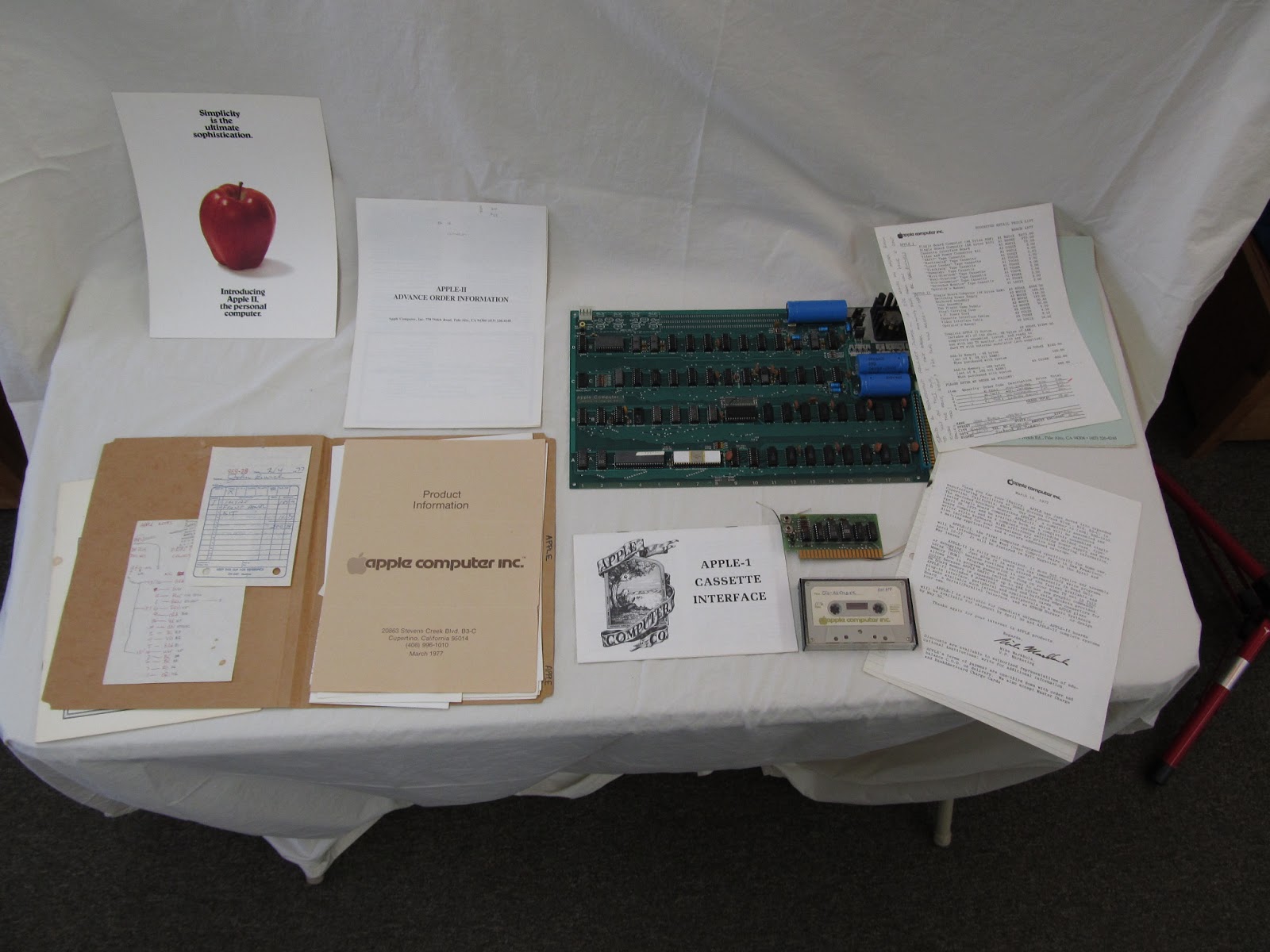
The Apple 1 as purchased from John Burch was only a single board as seen above. Steve Wozniak designed it using the 6502 microprocessor because it was very low cost compared to the popular 6800 or 8080 microprocessor. Owners had to add the AC power transformers, keyboard and TV as an output display device to get a simple operational computer. You can see the transformers and keyboard that was added to make my Apple 1 operation in the photos below. Even before all the Apple 1's were sold Wozniak realized that a much more plug and play computer would be more popular and started the design of the famous Apple 2. The Apple 1 and 2 were designed in total including the initial software by Wozniak. He was really a brilliant designer to make the computers with minimum amount of hardware and efficient software.
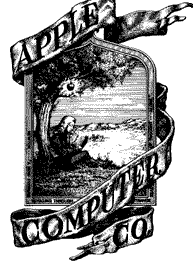
Original Apple logo
You can see this computer in the Apple 1 registry by Mike Willegal see -
Send a Tweet'CLICK' hashtag #KK4WW if you enjoy the blog or have a comment
My association with computers actually began in September 1957 when the Navy sent me to school at Remington Rand Univac in St. Paul MN. I was just out of high school and only 19 at the time. The computers in those days were really big room size vacuum tube monsters. It was fun and exciting to be a part of the Navy program to install one of the Univac computers at the War College in Norfolk VA.
In 1967 I started my career as faculty member teaching Electronic Instrumentation and Automation at Virginia Tech in Blacksburg VA. It was here that I become associated with microcomputers as a normal part of my teaching. I had many great experiences during this time and started collecting microcomputer memorabilia and continue to this day. To build the extensive collection I have today I advertised in various publications "Wanted pre1980 microcomputers for Historical Collection". This advertisement was placed in many computer & Electronic publications for more than 30 years. The most effective publication was 'Computer Shopper'. Running the advertisement for so long shows that repeat consistent advertising pays off. I had many calls from folks who had seen the advertisement for years and now were going into retirement or nursing home and call " I have been saving this computer for years but can't do it any longer and hope you can add it to your historical collection". Many times it was possible for me to add great computers and other items to the collection.
David introduces himself to you in the audio player above
David is interviewed by Robbie Harris of WVTF public radio July 29,2013.
David working on his Apple 1 purchased from Mr. Burch.
I have had about 10 Apple 1 Computers offered to me over the past 30 years. I keep a log of all the calls and still have the logs. Most of the Apple 1 computers were out of my price range however over the years I was in a position to acquire several including the one I describe in this blog.
I received a call from John Burch in the early 90's and he told me he was ready to part with his Apple 1 computer however all the collectors he had talked to wanted him to just give them the computer. The Apple 1 computers were selling at reported values of $10,000 to up to $50,000 during that time. I don't see how any rational collector would expect to get one free. Mr. Burch and I arrived at terms agreeable to both of us.
John told me he was the original owner of the computer and he had purchased it at a computer club meeting out of the back of a car from Steve Wozniak. (Steve Wozniak was the brilliant designer of the Apple 1 and 2). The Apple 1 did not come in any kind of case. This has beautiful wood case and I did not know who made the case. Some of the papers I received with the computer indicated it was from a Byte Shop so maybe it was one Wozniak was selling one for Byte Shop.He told me it was working when he sold it to me and I plan to make sure it is a working computer this year. I think I can do this myself but do have some friends near here who are very good and willing to help.
The serial interface card for the Apple 1
Many original manuals, data sheets, & cassette tape included
This is a beautiful computer and I hope to have it public display in the future.
Dr. John Titus designed and published a construction article about the MARK
8 Computer in the July 1974 'Radio Electronics Magazine'.Dr.
Titus was a graduate student at Virginia Tech and is given
credit for being the first to make it possible for an electronic hobbyist to build their very own microcomputer. The article
describes how to build the computer however the finished and made to operate.
Several were even made into rather complex control computers. We have one
in our Microcomputer Museum with lots of extra complex circuits and software to
make it into a process control computer.
hobbyist had to
obtain all the parts on his own. A company did make the bare printed
circuit cards available and the additional parts were a challenge acquire. This
limited the number of computers constructed to several hundred or less. To help
a 48 page construction guide was made available by the publishers of ’Radio
Electronics' for about $5.00. Most likely only a few MARK 8
microcomputers were ever
The publication of the MARK 8 computer in the July issue of 'Radio Electronics'
was the very first time a construction article was published. This was noticed
by the competing publication 'Popular Electronics' and followed in January 1975
with an article about the "MITS Altair 8800" microcomputer. John
was first with the MARK 8 and as a result many computer clubs and newsletters
were started to help computer hobbyist build and use the MARK 8.
Here is a the whole article in 'Radio Electronics' from Rich Cini Collector of Classic Computers web site.
Added 9-4-13
Original Mark 8 in our Museum display - Floyd Virginia
It is a pleasure to be a colleague and friend of Dr. John Titus. John and I worked together in the 'Blacksburg Group' in Blacksburg, Virginia(70's & 80's). During this time the group developed popular books about computers & electronics "The Blacksburg Continuing Education Series". The group also developed several popular microcomputer trainers, electronic teaching & development hardware and taught dozens of microcomputer workshops. John did the design and development of all our computers.
Update - Here is John last Column in "Design News" December 2013. John tells about 3 mentors in his career - Gosh I had no idea how John felt about those early days in Blacksburg Virginia. Thank you John for the nice words about our work together - it means a lot to me. Dave 3-31-14
"Bugbook Historical Microcomputer Museum" is the name of our Microcomputer Museum here in Floyd Virginia. This museum is managed by the LCF Group and the microcomputers have been collected over a 40 years time frame by David Larsen, a member of the LCF Group. Davids first experience with computers was in 1957. David was in the Navy and sent to computer training school at Remington Rand Univac in St. Paul MN. He started collecting the microcomputers while teaching at Virginia Tech in the early 70's. David's historical collection of microcomputers has 1000's of items and all are stored in a controlled environment. The LCF Group has a small part of the collection on display in the Village Green , Floyd,Virginia. David will be discussing the microcomputers in the museum display and others from his collection in this blog during the coming months.
The video attached to this post was made in August of 2011 and will give you and idea what is on display. We look forward to your comments and will do our best to answer and of your questions about microcomputers. Thank you.