Showing posts with label Floyd VA. Show all posts

Tuesday, October 20, 2020

Intel 8008 Microprocessor began as a 'Computer Terminal Corporation 2200" - an Electronic Data Terminal

Bugbook
Bugbooks
This is a poplar post and I updated it and reposted it. David Larsen
The first 8 bit Intel microprocessor -the 8008 was the result of designing the Computer Terminal Corporation "CTC 2200" logic into a single chip.  The CTC2200 was a successful project to design an electronic version of the 'workhorse' Teletype data terminal  of the 60/70s  - the Teletype was an all mechanical  communications terminal with hundreds of gears and levers. .  CTC contracted  Intel to design a microprocessor however the process was slow and CTC did not  use the design.The result was Intel had its first 8 bit microprocessor (8008).  See short story about the interesting origin of the 8008 at the end of this post.

We are fortunate to have this CTC 2200 in our computer collection and on display in the museum.

See video of this computer "CLICK"


  CLICK photo to enlarge
CTC2200 data terminal
CTC2200 data terminal 

CTC's TTL-based desktop personal computer, called the Datapoint 2200, was unveiled in 1970, with cassette tapes for 130KB of mass storage and 8K of internal memory.

The first end user sale was to a chicken farmer in the South who programmed the CTC2200 to write payroll checks. So I you could say a chicken farmer was the first  user of a programmable microcomputer.


Bugbook Historical Microcomputer Museum
CTC 2200 with case removed


The CTC 2200 is densely packed with Small Scale Integrated circuits and other parts. The mechanical design seems to be well done and the unit is solid and sturdy. ( also very heavy )


CTC2200 keyboard
CTC2200 keyboard

The design includes about 100 small scale integrated circuits along with discrete components- transistors - resistors -diodes and capacitors. In this photo you can see 4 printed circuit boards under the display and in back of the keyboard.  Their are 4 printed circuit boards under the tape deck area and 4 memory boards next to the CRT display.


CTC2200 back panel heat sink
CTC2200 back panel heat sink 

The unit was designed to fit in the same area as an IBM Selectric Typewriter. This did not give much room and the unit is packed with cards and circuits.

Here you see the large heat sink on the back of the terminal. It is heavy and weighs about 40 lbs.


CTC2200 memory cards


The 4 memory cards each contain 4Kb of RAM for a total of 16 Kb. The CTC2200 machines with 16Kb sold for $16,000.


CTC2200 cassette tape decks


The unit had  2 read-write cassette decks for 130KB of mass storage.


CTC2200 CRT HV and driver circuits


A view of the high voltage for the CRT and Memory area.


CTC2200 serial # 498 on PC board
CTC2200 serial # 498 on PC board 


The only serial number I have found so far is 498 on the corner of this card.


Here is some great research about the first microprocessor - Ken Shirriff's Blog 


Short story about the origin of the Intel 8008 microprocessor.

The Teletype was the communications terminal used from the late 50's until in the 80s - first as a data  terminal connected to the telephone system with a modem. It was used to send messages to users and mostly for sending and receiving telegrams. Later the Teletype was used for a minicomputer printer and paper tape punch to store the data.  Long distant voice calling  were so expensive and unreliable it was rarely used  in the 50's and 60s'.

The Teletype was a totally mechanical device that could decode 8 bit data strings - ASCII code - and print all capital letters on paper & also punch paper tape for permanent Storage of the data. The Teletype could also read the paper tape and convert the code into the 8 bit serial ASCII data for transmitting over a telephone line using a modem. The word Byte for 8 bits of data most likely came from this sending and receiving alphabetic characters as 8 bits of data.  
                                                                                                                                                                                                                                                                 CLICK photo to enlarge
ASR 33 Teletype
Teletype 
The Teletype was a great invention however it was a mechanical monster with 100's of cams and levers that could and failed often. It was a mechanical device and very noisy & distracting in and office.

In the end of 1960's, 2 graduates at Case Western Reserve University in Ohio, Harry Pyle and Victor D. Poor, came up with the idea of a high density integrated circuit which would be programmable. Harry and Victors ideas were used to create the logic of the CTC2200 and this became the code for the 8008 microprocessor. When transistors and more importantly integrated circuits became available and all electronic version of the Teletype became possible.

The Computer  Terminal Corporation produced an electronic replacement for the Teletype the "CTC 2200". The CTC 2200 was actually programmable terminal using a custom designed 8 bit computer. The computer was made from discrete components and and small scale integrated  circuits. Microprocessors had not been  designed in the late 60's when the CTC2200 was developed.

The engineers at CTC did have the idea to put the computer logic they had designed into the CTC2200 on a single chip  - making a microprocessor.  A design team went to Intel to have them design and make a microprocessor  using the logic in the CTC2200. Robert Noyce of Intel when approached with this project did not like the idea as he thought a computer on a chip would hurt the memory chip market of Intel by competing with computer makers using the Intel memory chips.  However Robert Noyce did agree to make the chip for $50,000.

The CTC engineers also went to Texas Instruments and ask them to make the same chip to be sure they had a backup source.  The Texas Instrument chip did not function properly and was not used. The Intel chip was a long time in development. The CTC team decided to just build the 2200 terminal with there current design of about 100 small scale integrated circuits and give up the rights to the intellectual property rights for the   Intel microprocessor design --and did not pay the $50,000 to Intel.  Giving up the intellectual rights to the microprocessor is among the worst business decisions ever.

Intel went ahead with the full development of the microprocessor and called it the 8008. The microprocessor used the same digital logic and operational software codes as CTC2200 .

The computer logic in the CTC2200 then was an original 8 bit computer that used the 8008 software code and was  the beginning  of 8 bit computers (8008 microprocessor) for Intel.

Here are some links to more complete stories of the CTC2200 / Intel story. Some of the information I used came from these references.
Computer World 
History of Computers
San Antonio "Express-News"
Wikipedia

Their is a lot more to this very interesting story of how the first Intel 8 bit 8008 microprocessor came about - here is the REST of the STORY 

David G Larsen
I  remember for many years I did not think I would find a CTC2200 and wanted to have one for it is one of the first programmable microcomputers. During the late 80's I was able to find not only this fine example and the source also had a  model the CTC1100. The CTC 2200 and 1100 now are part of the "Bugbook Historical Microcomputer Collection"


Monday, November 9, 2015

Computer Museum Curator's Birthday -David Larsen KK4WW is 77 November 17,2015

KK4WW, bugbook computer museum
LR brothers Howard, Chris & myself Dave
This time of year I always reflect on where I have been for the past 77 years (November 17,1938) and what is ahead for the next unknown years. A reflection on my family of 5 brothers & one sister always comes to mind first. The family is small now with only 3 of us brothers still kicking dirt above ground.  Chris (83 years),brother Howard (94 years) and myself  remaining. My parents were just great folks and they grew up in hard times during the early 1900's and Great Depression. Grandparents, Aunts & Uncles long gone now and memories faded.
Happy Birthday Dave


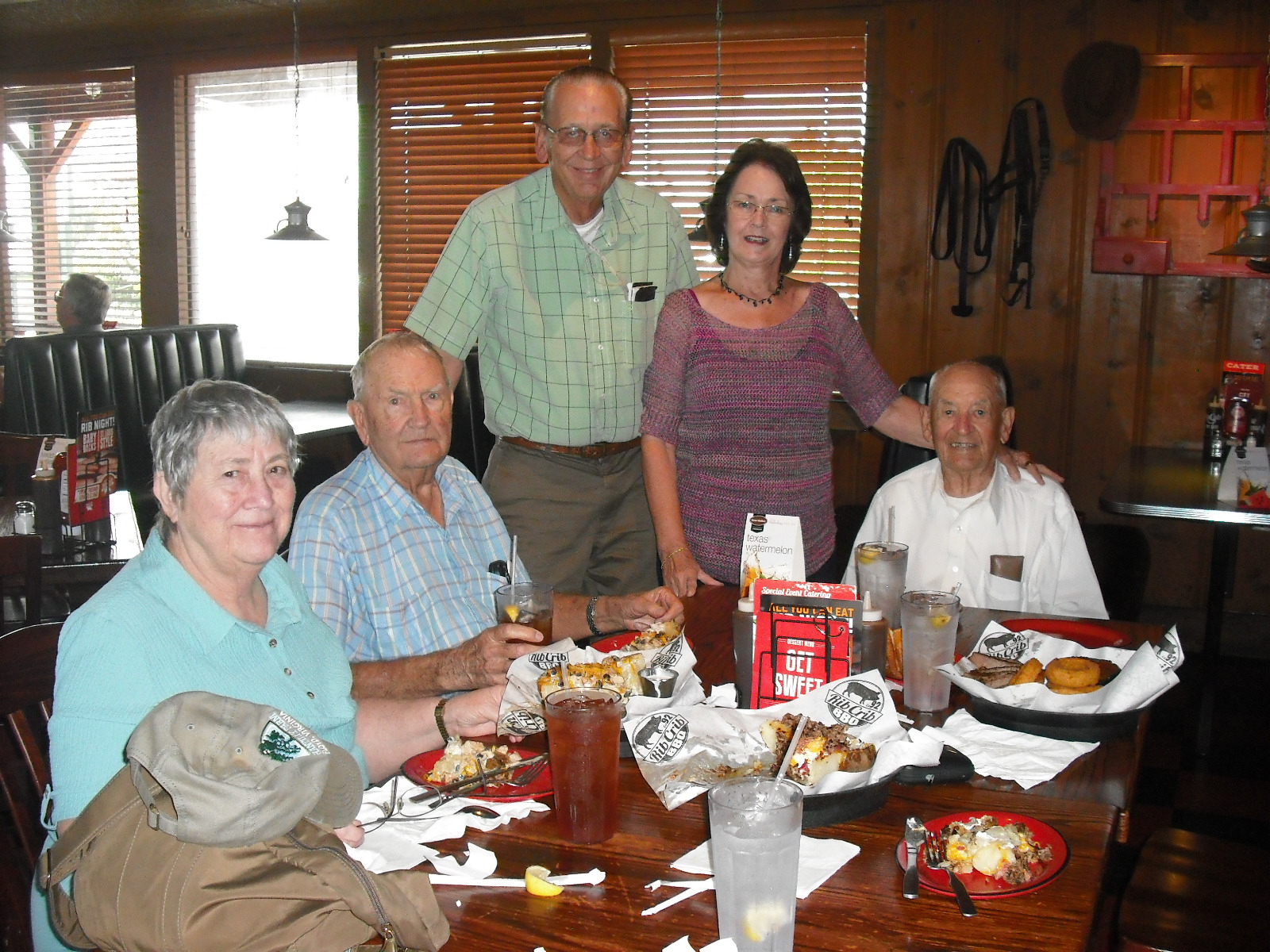
LR Chris & wife Thema, Me & wife Gaynell,
Howard
We had a great time during our September 2015 visit to home of Howard - Missouri.

Here we are in Branson having a wonderful BBQ lunch at the famous "BBQ Hut".

This is all the family I have still remaining - down to some second cousins that I do not know. All parents,aunts & uncles, first cousins have passed on.Don't wait to have that family time.

I grew up during the 40's & 50's & the Aunts & Uncles were scattered far and wide from my home and I did not get to know any of them very well.   Cousin's - their are many dozens and I know only a few of them - This is so sad for me.

I do get together as often as possible with my two brothers and always wonder - Will this be the last time? I wrote this in 2014 and we  did get together again in September 2015 - we are sure all getting to look older and my brother Howard at 94 is still living an independent life in his own home but getting a bit on the feeble on his feet.

Brother Howard is a writer and he wrote this "Ode" about our mother. He is correct she was a great Mom always showing us her love. Mother was born in 1899, 99 years old and died in 1999. We enjoyed her loving care for many years.
-------------------------------------------------------------------------------------------------
An Ode To Mother”

I was standing by mother's bedside, watching and praying, as she lay in her tilted bed. Passing the time was very sad. God entered my soul and changed things. “Your mother is on her way to heaven to spend the rest of her days with dad.” Dad went to heaven several years ago. I lost my best friend.

You have been such a comfort to me mom. Your ninety nine years on earth have finally come to an end. As I walk this earth and get older each day, I'll have the rest of the family to enjoy as they work or play.

My children grew up knowing their Grandma. Her love was something they always would feel. At the end of the day before leaving, you would make them a tasty cooked meal. You never had a harsh word, always giving praise when I was around. Mothers and Grandmothers like you are someone that's hard to be found.

When I was just a youngster, we lived on a farm in the woods. You were always up early doing chores and working real hard. When that work was finished you chopped wood in the yard. We bathed ourselves in a galvanized tub. You were always there to give us a scrub.

In the winter you were outside working sometimes in the wind and blowing snow. You never gave up till your face turned red. Then you would go inside, clean up, put some wood in the old cook stove and make cinnamon rolls, and homemade bread. These are the things you did all your life, besides making my dad a wonderful wife. You lived several years after dad passed away, just part of your family is left here to stay.

I will stay here for the rest of my life remembering the good, forgetting the sad. You will be resting in heaven while living with dad. “Goodbye Mother” As you have been lifted above, you have left this earth with all of my love.

I am feeling good now forgetting the sad. When you are resting in heaven say hello and give my love to Dad.
Your Loving Son Howard
--------------------------------------------------------------------------------------

Bugbook Historical Microcomputer Museum
Dad Will, me  & Mom Ruth  1945

This photo brings back the good memories of my mother and father. I was 7 years old in 1945 and in the back ground is a 1941 Chevrolet - just delivered. Dad ordered the Chevy in 1941 however World War ll delayed the delivery by 4 years. 


David Larsen
I am counting down - only 23 to go ?  Could be 23 years or 23 seconds & I vote for the 23 years but sure know I don't have full control of the timing.  I am looking forward to slowing down in the next few years - don't need to travel much as been there done that - I would say just enjoy our children, grandchildren & great grandchildren and the great outdoors we have here in the Blue Ridge Mountains of Virginia.


Tuesday, August 18, 2015

Microcomputer Computer Museum curator looks at old times, David Larsen KK4WW

Bugbooks
info click
When writing one of my blog post or working in the computer museum I always think about events in my past various careers. This may be of interest only to me however here are few milestones that came to mind tonight. My wife and I also get to talking about old times now and then and it is fun to look back over my 76+ years.

Bugbook Computer Museum
David Larsen W7VZW
My growing up years were in Oregon during the 40's & 50's.

This photo is my amateur radio station in 1954. My interest in electronics and amateur radio would determine my career for the next 51 years.

Graduated from Oregon State University in 1963 after a 2 years of duty in the Navy.

To enlarge "CLICK" on photo,s
Bugbook Computer Museum
David Larsen 1957 computer school
Started Navy duty in September 1957 and was sent to school at Remington Rand Univac in St. Paul, Mn. This was so long ago that the famous Dr. Grace Hopper was there at the same time working as senior scientist developing computer programming. She wrote the very first compiler program. Dr. Hopper was 51 years old at the time I was at Remington Rand Univac. She retired from the Navy in 1986 at 80 years old as  rear admiral and lived until 1992.


Bugbook Computer Museum
David did complete the training 

While in training for the Navy at Remington Rand Univac I did manager to complete several courses of study.

This was my first experience with computers and it created a curiosity about computers that has lasted to this very day.


Bugbook Computer Museum
David's First design project at VT
After graduating from Oregon State University in 1963 I worked as an engineer for several companies before my 31 years as a faculty member at Virginia Tech (VT).  The companies were Raytheon, Konel, Fairchild, and Varian Associates then on to VT in 1967 as a faculty member.

This photo taken in 1968 was one of my first projects at VT. I designed some circuits that would take the output of a digital multimeter and print & punch out the information on  paper tape using the ASR33 teletype. It may not seem like much now but data was read off a strip chart recorder and then manually digitized for computer entry before I designed this automated digital data logger.  A few years later I did some consulting for IBM and Analog Devices and they both built and sold commercial products using my ideas.

Bugbook Computer Museum
David teaching PDP-8
Interfacing workshop 1970
During my 31 years at Virginia Tech I taught many short courses in "Data Automation and Computer Instrumentation.  These workshops were just great and also provided travel to dozens of countries. Tonight just received an email from Nick Cloyes who attended one of our workshops in 1976 - a lot of reminiscing with this.


This photo is one of the early workshops using a PDP-8L Minicomputer about 1970. I did not do this work alone and was joined by various faculty during the 31 years at VT. Some of my colleagues were professors Dessy, Rony and Field, Jon Titus & Chris Titus at the Blacksburg Group and others on various occasions.


Teaching / Outreach award in 1995.
Virginia Tech, VT
David Larsen Outreach Award in Spectrum
It does not seem like 20 years ago - I was awarded the one of two of the very first Outreach awards at Virginia Tech ( VT ) . This was a real highlight and honor for me my last year of active teaching as a faculty member of the Chemistry Department at VT. Here is a little more information about this award.


Bugbook Computer Museum
Outboards - digital teaching aids

About 1974 I designed some very simple digital teaching modules and called them "Outboards". They were marketed by E & L Instruments of Derby, CT along with the Bugbooks and other products developed my colleagues at the Blacksburg Group.


Bugbook Computer Museum
Outboards


A catalog page from E & L Instruments showing a few of the "Outboards" in 1975. E & L also sold most of the digital products developed by our "Blacksburg Group" - some of the products were the MMD-1 computer, Bugbooks, Outboards, and other digital teaching equipment. See more here "CLICK"


Bugbook Computer Museum
teaching a digital electronics workshop 
Digital electronics were new to everyone in the late 60's and we taught many short courses to Virginia Tech faculty and researchers in digital electronics - learning all about Gates and Flip-Flops.

These folks are using the Outboards and powering the experiments with a 6 volt lanter battery.

That is me leaning over at the back of the room near the screen in 1974.

Bugbook Historical Microcomputer Museum
Their are many more milestones and stories along the way for me however; I have ended up at this time with a wonderful collection of microcomputer memorabilia and writing this blog. A small part of the collection is displayed in the " Historical Microcomputer Museum"  Floyd,Va.  I sure have lots of fond memories working with these old computers.


David G Larsen
David G Larsen


 "by David Larsen" KK4WW Computer Collector / Historian 
      
              Join museum on Twitter   Join museum on FB


Saturday, June 27, 2015

EPROM - Erasable Programmable Read Only Memory - computer memory


Bugbooks
info click
Computer Museum Bugbook Bugbooks
1702A EPROM
The first (1971) EPROM ( Erasable Programmable Read Only Memory ) 1702A changed computing forever. The 1702A is  Nonvolatile memory chip and does not lose its contents (program) when power is turned off.  RAM (Random Access Memory)  used at the time was volatile - the contents is lost every time power was turned off.  Being able to program the microcomputer and have the program or data stay resident when power is turned off was essential. The EPROM was invented by Dov Frohman of Intel in 1971, who was awarded US patent 3660819 in 1972.

Click on photo to enlarge
Computer Museum Bugbook Bugbooks
1702A EPROM

It is interesting to look though the quartz window of the EPROM integrated circuit (IC) at  the die inside. You can see the little gold wires that connect the die to the pins on the holder.  The quartz window allows the memory to be erased by exposing it to UV light and then it could be reprogrammed. More information about EPROM's "Wikipedia CLICK"


This is a revisit to EPROM's - see my earlier post "Vintage EPROM Memory 1702A -Made microcomputers, robotics and micro-controllers practical 1971 CLICK"


Computer Museum Bugbook Bugbooks
1987 reciept for 359 EPROM's


In 1987 I purchased a nice collection of 359 EPROM's from Computer Surplus Store for $229.85.  This looks like a good deal today at 50 cents each.


Computer Museum Bugbook Bugbooks
1987 receipt for 359 EPROM's


Date & Price


Click on photo to enlarge
Computer Museum Bugbook Bugbooks
1702A 2708 EPROM


Here  are the 359 contained in 30 storage tubes. Almost all the EPROM's are the beautiful ones in a white ceramic package and gold pins.

This shows hoarding as I indicated in my last Blog.


Computer Museum Bugbook Bugbooks
1702A 2708 EPROM close view
A closer look at some of the 359 EPROM's.

I purchased these 28 years ago with the idea of using them to make a display plaque to put on a desk or hang on the wall. The white ceramic EPROM's with the clear quartz window a very interesting to view and with some additional photographs and history with the EPROM it would be an eye catcher for sure.

You can get a good look by CLICKING on the photo.


As you can see I have not made the displays using the 359 EPROM's and would like some help or suggestion about how to put them good use . Of course I could sell them on Ebay but that would not be much fun. Contact me here with your idea's "Contact David CLICK"

--------------------------------------------------------------------------------------
Some of the EPROM'S  in our inventory are in applications like the board below.
Click on photo to enlarge
Computer Museum Bugbook Bugbooks
menory card 2716 EPROM
I have hundred's or perhaps 1000's more of the EPROM'S in the museum warehouse. Many are in the nice white package.

Here is a typical use of EPROM's - this board contains (16) 2716 EPROM's . The operational program for this computer is contained in these 16 nonvolatile memory chips. The 2716 contains 16K Byte of memory.

Can someone help me identify this early microcomputer board??


Computer Museum Bugbook Bugbooks
2716 EPROM


Better view of the 2716 chips on the computer board shown above.


----------------------------------------------------------------------
A small collection of EPROM'S
Click on photo to enlarge
Computer Museum Bugbook Bugbooks
Intel 1702A EPROM


A small batch of 1702A chips unused in the original Intel Package. The package is also interesting and a collectible item.


Computer Museum Bugbook Bugbooks
Intel 1702A EPROM 


 New unused Intel 1702A EPROM chips.


-----------------------------------------------------------------------------------------------------------
Here is a video I made in 2009 about the 1702A EPROM "CLICK"
-----------------------------------------------------------------------------------------------------------
Bugbook Historical Microcomputer Museum
David Larsen
I have hundreds of EPROM's in the museum warehouse and many of them are still on computer boards like S100 memory cards. Please help with some innovative and interesting uses for all these beautiful IC's. Still having fun at 76 yrs. 
           ."by David Larsen"  KK4WW Computer Collector Historian 

Sunday, June 21, 2015

Computer Museum Curator is a hoarder of good Memorabilia

Bugbooks
info click
These Gerber bottles are from 1963 when my son was born and I was working at Konel Electronics.  Konel made marine radio transmitters and used a lot of stainless steel hardware.  The hardware nuts and bolts that fell on the floor were just swept up and tossed in the trash. It was not worth the time to sort the little hardware pieces & I saved some useful items. Sidney Koningsberg  owner of Konel was a great fellow. He gave me my first job out of college in 1963 and loaned me $3000 for a down payment on my first house.

Click on photo to enlarge 
David Larsen, Computer Musem
Konel Marine Radio Transmitter  1963


This 52 year old Gerber bottles may be collectible items however  for me they just contain useful hardware from 50 years ago. I find uses for this hardware often.

A  video of hoard of Gerber Baby Bottles "CLICK"


Gerber Baby food bottles


Some have red tops and some blue - I don't know just what that indicated. A bottle collector would know.


Computer museum, david Larsen
Konel Marine Radio Transmitter 

I saved some of the discarded stainless hardware nuts and bolts for my own use. I used these Gerber jars to store the little nuts and bolts and here we are more then 52 years later with the remaining hardware. It has been useful all these years to be able to use the hardware as needed and it is often I do need a few of these parts for repair.


Click on photo to enlarge 
Konel Marine Radio Transmitter 


More hardware -  I have about 10 of this bottles with various hardware items stored.


Computer museum, curator
Konel Marine Radio Transmitter 
This is where I gathered the hardware stored in the Gerber bottles 53 years ago.
This Konel Marine Radio Transmitter was built by the company I worked for when I graduated from Oregon State University in June 1963. I had a lot of experience with transmitters and receivers - Ham Radio at 15 years old ( and still at it 61 years latter) - 2 years in Navy are Radio technician. I also worked 2 years during my Summers while in college for Mr. Koningsberg .

This Konel transceiver is on display in our museum.


Little video of this Konel transceiver "CLICK"
-------------------------------------------------------------------------------------------------------------------
A good day in the museum - 6-21-15


Computer Museum, David Larsen
Kids day 2015 Amateur Radio
Amateur Radio Station N4USA used to make contacts nation wide on this Kids Days - a special day when Amateur radio operators brings kids into their station for the experience of talking to other children direct by two way long distance short wave radio. At N4USA we made contact with stations and kids in NY, Montana, Illinois,and other states.
 Bugbook Computer Museum.www.n4usa.com www.fairs.org


computer Museum David Larsen
Kids day 2015 Amateur Radio


The Kids day ham operators L-R Matt Standberry, Mark Ward, David Larsen, & Tom King.


Bugbook Historical Microcomputer Museum
David Larsen

 Still having fun at 76 yrs. 

           ."by David Larsen"  KK4WW Computer Collector Historian