Showing posts with label Digital Equipment Corporation. Show all posts

Friday, September 18, 2015

PDP-8 Minicomputer Interfacing - How to connect your PDP-8 to the outside world 1972

Heath Schlumberger
Heath Schlumberger logo
BugbookHeath / Schlumberger computer interface brings the inside of your PDP-8 computer outside to the real world - 1972.        This was the advertising byline for the interface unit.
                                           
Click photo to enlarge -
Heath Schlumberger EU-801E PDP-8 Interface

 The Heath/Schlumberger interface unit brings all the address/data bus and control signals to the outside world in the instrument you see to the left of the PDP-8 computer in the photo. I have found very little information on the web about this unit.

Here is the interface connected to a PDP-8L minicomputer with a graduate student testing the operation.


 I was a consultant for the Heath/Schlumberger company on this project - Here is the short story of this adventure.

 Dr. Howard Malmstadt at the University of Illinois was a pioneer in the teaching electronic instrumentation to who people who were not engineers but were scientist and technicians needing to know about electronics and electronic measurements. Howard  did this work in the early 1960's with the help of Dr. Chris Enke at Princeton University.  Dr. Malmstadt named this teaching technique and equipment "Electronics for Scientist".  The course work consisted of a text books and a equipment in a teaching station.

I was fortunate in 1967 to attend 4 week workshop"Electronics for Scientist" at the University of Illinois taught by Dr. Howard Malmstadt.  Professor Malmstadt invited me back to be an assistant for his workshops for the next 4 Summers. Working with Dr. Malmstadt during this time developed into an invitation to consult with the Heath Schlumberger company in Benton Harbor, Michigan. Professor Malmstadt and Professor Chris Enke were working with the Heath Schlumberger company on the  interface package for the PDP-8 minicomputer.This device was the EU-801E. It simplified the teaching of computer interfacing/automated instrumentation and designing projects using PDP-8 minicomputers.

While writing this blog I was able to make contact with Chas Gilmore the Engineering Manager for this product at Heath Schlumberger.  Chas had some interesting information about the development of the EU-801E.

----------------------------------------------------------------------------------------------------------
 Chas Gilmore - Here is a synopsis of what I remember of the EU-800 saga--Dave may well be able to add more. Way back when, I worked with Dave Larsen when he was consulting on the EU-800 Series. He was at Blacksburg--Virginia Tech at the time if I remember correctly. I was the design engineer on the EU-805,
When I got to Heath in 1966 that system was in its very beginnings and the design was mostly discrete components (jam packed cards) and was pretty impractical. They then decided to use RTL but still struggled with cards, especially for the instrument which were really too complex. I found digital integrated circuits intriguing as can be and started doing investigation in that area on my own. That was when I found this new technology called TTL. So, just for grins I took some of the functional blocks, they had designed (one card was a decade counter and it drove a second card that had latches and Nixie tube decoder/drivers--again all discrete) and redesigned it in TTL. That reduced the design to a single card and not a lot of parts. I took it to the project engineer who scoffed at the design. That got my back up so I took it to the department Chief Engineer--our common boss. He was intrigued and arranged a meeting with Malmstadt and Enke. They were also very intrigued--and liked using the latest technology. The net result was the other guy was relieved of project responsibility and I became the project engineer--and the whole project went to TTL. We also boosted the speed of the counter from 2 - 3 MHz to 12.5 MHz (a truly blinding speed!!).

I still have manuals for these products but no longer have either an EU-805 nor an EU-801.

The EU-801-E came along later as a companion to the recently introduced PDP-8L--a PDP-8 computer available for just under $10,000. What a breakthrough. By then I was the Engineering Manager for the department. This extension of the EU-800 series came along after the EU-805 and EU-801 had been on the market for a couple of years. Unfortunately, none of it sold terribly well and it didn't take long for Jimmy Lee (who had been brought in to head up the Scientific Instruments Department and was my boss) started to push for non-EU products (all of the EU-series were related to the Malmstadt/Enke Electronics for Scientists systems which were created as laboratory hardware which supported experiments for the Malmstadt/Enke textbooks.) I don't remember exactly when Dave became associated with the project but it may well have been in conjunction with the EU-801-E.

------------------------------------------------------------------------------------------------------------------
PDP-8 minicomputer Interface
Advertisement Heath Schlumberger EU-801E


Here is an advertisement for the PDP-8 Heath/Schlumberger interface equipment in the June 1972 issue of the Analytical Chemistry  journal.

This is about the only item I can find online about this Heath/Schlumberger product.


I have one of the interface units in my museum warehouse and this is the buffer amplifier used to connect the PDP-8 interface signal to the the interface  trainer.


Card to access all the PDP-8 I/O signals


The computer signals from the buffer box come out to this interface card giving you access to the computer address and data bus plus control signals. 


Bugbook computer museum
Heath Schlumberger Digital Trainer
The interface card above plugs into this unit for power and wiring your custom interface.


Heath Schlumberger EU-801E PDP-8 Interface


Here is a view of the interface unit wired to a PDP-8L with a custom interface being tested.


I found more photos of the PDP-8 interface system see album


bugbook computer museum
David Larsen
These units never became widely used - I would estimate that only a few hundred were sold. It was just to complicated for most people to consider making their own custom interface to a minicomputer. 

This is me using one of the interface units teaching about minicomputer interfacing.


Professor Dessy and I taught a number of workshop using this equipment until the microcomputers made the PDP-8 minicomputer obsolete.  Teaching these workshops away from home was a real challenge - we packed the PDP-8 in a crate with the other equipment and sent it ahead for the workshop. This must have been a least 400 lbs of equipment.  We went as far as San Francisco for one program and in the early 70's. This was the start of my 22 years of teaching various Computer Interfacing and Instrumentation workshops in many parts of the world including the old Soviet Union.


Heath Malstadt teaching station

My experience with Dr. Malmstadt helped develop my teaching technique used for  31 years as a faculty member at Virginia Tech. I used his books and equipment as part of my courses in "Electronic Instrumentation".

 Here is advertisement of Professor Malmstadt's teaching station sold by Heath Schlumberger 1963.


I owe Dr. Malmstadt a lot of gratitude for all the help he gave me in my early years of teaching. Howard was one of the most kind and humble professors I have known. He was just a great and wonderful person.


Take a look here  about Dr. Howard Malmstadt's work at the University of Illinois. Dr. Malmstadt passed away July 7, 2003.


David G Larsen
David G Larsen


John Simkiss visited the museum on Friday September 4th and picked up
his Altair 8800 computer. The computer has been restored to full working condition and is low serial # 414. We had a great day talking about the history of microcomputers and visiting the museum & warehouse.

"by David Larsen" KK4WW Computer Collector / Historian         
            Join museum on Twitter   Join museum on FB


Sunday, September 28, 2014

PDP11/10 Vintage Minicomputer in Bugbook Historical Micrcomputer Museum

Our museum has only one minicomputer - (PDP11/10)   on display. We think it is a good idea to have a minicomputer to make comparisons with the microcomputers.  This PDP11 was  made
Bugbook Historical Microcomputer Museum
PDP11 computer
Bugbooks
info click
in 1971 and cost about as much as a small house. It is easy to see why not many people could afford to purchase a minicomputer for home use. When the first microcomputers became available they were instantly in demand. The Altair 8800 first microcomputer kit made possible home computing  in January of 1975. The Altair 8800 sold for $395 however it was very limited in capability without a lot of skilled work and additions to the computer. The Altair was designed by Ed Roberts. Ed thought he could sell 500 computers however I understand he had 4000 orders the first several months. We are fortunate to have one of the very first Altair 8800's in our collection -- Serial Number 23.


 The PDP 11/10 in the Bugbook Historical Microcomputer Museum by David Larsen


Click photo to enlarge
Bugbook Historical Microcomputer Museum
PDP11 and David Larsen, Curator with PDP11

Digital Epuipment Corporation (DEC) made mincomputer from 1960 to about 1990. Microcomputers put DEC out of business with very good low cost computing. The first PDP computer was a PDP1 in 1960. Only about 3 of these computers still survive. The Computer History Museum in Mt. View, California has a restored PDP1 restored and in nice working condition.


Bugbook Historical Microcomputer Museum
PDP11/10 minicomputer


Many versions of the PDP11 were made and about 600,000 were sold during its 20 year lifetime.


Bugbook Historical Microcomputer Museum


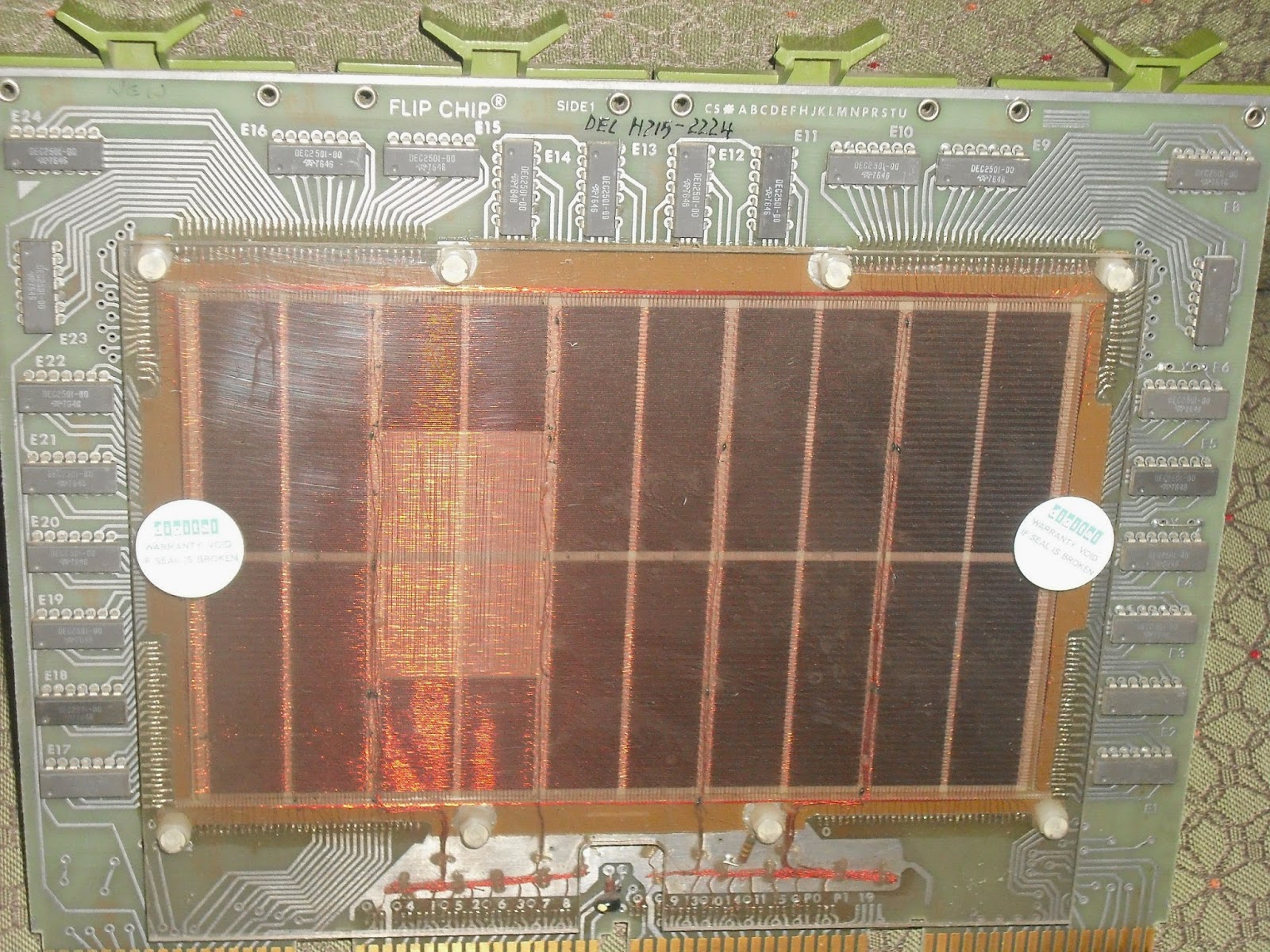
The core memory is nonvolatile and does not lose its memory when powered off for the day. This module has very tiny cores -probably  16k words of 16 bits each.


Magnetic core memory module PDP11/10

Click this link for a verbal description.The PDP 11/10 

David Larsen


Sunday, July 27, 2014

Vintage Computer PDP8S now up and running.

Bugbooks
info click
Here is an update on the Digital Equipment PDP8S that was hidden in my museum warehouse for over 24 years.


Click photo to enlarge 
Bugbook Historical Microcomputer Museum
Lyle Bickley & his PDP8S


Lyle Bickley new owner of minicomputer PDP8S serial number 203 reports on 7/18/14.


Hi Dave,

I was chatting with Michael from the RICM and was about to ask him to
watch the video on your website of you finding and opening the box
containing the PDP-8/S you sold me. But I couldn't find it on your
website. - (Here is the link to video- & here is link about my visit to Lyle in California - Dave)

BTW: Since we last chatted my PDP-8/S has been up and running most of
the time. A couple of weeks ago, another transistor went out - and
memory began to fail. I found and replaced it - and now it's working
100% again. So far I've replaced a total of about 32 transistors and
over a dozen diodes.

I recently went through CPU and memory timings in great detail - and
now they meet all of DEC's specifications.

My 8/S passes all DEC diagnostics - and runs FOCAL w/o a hitch.

Bob build a cool I/O interface for the 8/S (and made one for me, too)
that emulates a TTY, high speed paper tape (partial), A->D, D->A and
incremental plotter. He does the hardware and I'm in the process of
modifying the drivers in FOCAL to support all of the above ;)

I hope all is well with you and Gaynell!

Cheers,
Lyle

David Larsen
David Larsen

Just great to have this PDP8S with Lyle and up to date running condition.

"by David Larsen"  KK4WW Computer Collector Historian   
   Join museum on Twitter   Join me on FB

Thursday, December 19, 2013

Vintage Computers -First PDP computers from Digital Equipment Corporation early 1960's


 Lyle Bickley tell story of how Digital Equipment Corporation (DEC) started to make their first Minicomputers.

Digital Equipment Corporation DEC
DEC
Bugbooks
Bugbooks
How and why Digital Equipment Corporation (DEC) started to make minicomputer in the early 1960's. DEC was already making digital modules for science and industrial use. These consisted of the usual AND , OR , NOR, NAND , NOT gates and various filp-flops. Other special modules were made for instrumentation as well. 

Having all this digital capability DEC engineers wanted to use the modules to make a computer. Management resisted this for fear of competition from big Blue (IBM).  Management finally gave in however the computer could not be called a computer it was called a "Programed Data Processor" or just PDP.  The first was the PDP1 soon followed by the PDP8. Folks began calling them minicomputers.

These early PDP computers  are in great demand by collectors however it is believed only 3 PDP1's still exist and the only one operational is at the Computer History Museum in Mountain View, California.  Later models are available but the very early ones - PDP8, PDP8S are difficult for collectors and computer retro  folks to find. I was very fortunate to have acquired several original PDP8, PDP8S and PDP11/70 computers. My interest is more with historical microcomputers. The PDP minicomputers in the "Bugbook Historical Microcomputer Museum" have now been pasted on to other retro collectors of minicomputers. You will some of my past blog posting about these transfers/collectors.

PDP1 Minicomputer
PDP1 Minicomputer 
Photo of DEC PDP1 minicomputer at the Computer History Museum in Mountain View, California.  Lyle Bickley (seated at the control panel) is on the PDP1 restoration team at the museum.  This is the only operational PDP1 in the world.

Video of the PDP1 restoration story by Lyle Bickley 'CLICK'

Photo L-R My wife Gaynell Larsen - Bob  Rosenbloom and Lyle Bickley. This visit was in October 2013.


KK4WW
David Larsen
Thank you Lyle Bickley for allowing me to make this audio story and publishing it on my blog post.  The recording was made while touring the Computer History Museum in Mountain View, California --- lots of background noise however I found the story very interesting and I hope you do as well . Thank you for taking a look - listen.

 "by David Larsen"  KK4WW Computer Collector Historian   
   Send Message CLICK   Like us Click


Monday, October 28, 2013

PDP1 Vintage Computer at the Computer History Museum - Mountain View , California


Bugbooks
Computer History MuseumThe visit to the Computer History Museum in Mountain View, California was insanely great - it was 56 years ago my career in computers started with school at 'Remington Rand Univac' in St. Paul, MN.  Much of the old things I worked with long before microcomputers were on display with excellent documentation.

Lyle Bickley is a volunteer at the museum and is on the PDP1 team. Lyle not only demonstrated the PDP1 but gave us a complete tour of all the displays. The PDP1 is a computer I have never had the opportunity to use or see - the only operational one is at the museum and we were able to play "Spacewar!" on the machine.

Video story of PDP 1 history by Lyle Bickley below photo's.

Click on photo to enlarge 
Lyle bickley PDP1 Computer

 Lyle Bickley team member for the PDP1 at the
Computer History Museum in Mountain View, California.
The 2 boxes on the railing black knobs are for playing
 "Spacewar!" on the PDP1.


Lyle bickley PDP1 Computer


L-R David Larsen, Bob Rosenbloom & Lyle Bickley
at the PDP1 Computer. Lyle demonstrated the PDP1
operating and we all played "Spacewar!".


Lyle bickley PDP1 Computer


L-R Gaynell Larsen, Bob Rosenbloom & Lyle Bickley.


PDP1 computer DECLyle told us all the PDP1 computers were custom made and were all a little different. This large photo in on the wall in the room with the PDP1 looks much different with additional display panel and three additional racks of equipment (communications controllers,
etc.).   When restoring the PDP1 at the museum Lyle told us they could not find diagrams or schematics that were a good match for that machine and they had to do some guessing and trial and error testing to make the machine operational. The team worked for 1.5 years restoring the PDP1.


Google Bicycle


Many different historical items on display - here is a Google Map bicycle and car.


                                                             Video of Lyle Bickley telling
                                                             some history about the PDP1.


gaynell Larsen
David & Gaynell Larsen


."by David Larsen"  KK4WW Computer Collector Historian   
   Send Message CLICK   Like us Click

Wednesday, September 11, 2013

PDP 8S Minicomputer discovered hidden in warehouse

Bugbooks
Bugbooks
PDP8S minicomputer
PDP8S
                           Computer Collector Lyle Bickley now has this computer in his collection.
I received this PDP8S minicomputer from a fellow collector in 1990 and it has remained unopened for all these years. Desiring to focus on the historical microcomputers  I have found new homes for most of my minicomputers. It was now time to open the box for the very first time. My friend Clement Pierre Lewis visiting from Dominica helped open the box and make the video. The computer and box weight about 100 lbs so it was a two person effort.  It was fun to open the box - sort of like early Christmas and I am very pleased with the condition of the computer.
A video  opening the box with PDP8S inside - This was fun

PDP8S minicomputer
Here is the box PDP8S was in for the past 24 years.
The computer is about 50 years old so it was it has
been in this box for 1/2 of its existence. The wooden
box is rare these day so maybe I should keep it as
example of how it was shipped in the old days.
PDP8S minicomputer

 The PDP8S computer is in good condition and
has interface cables to attach to a peripheral
device. Computer made by Digital Equipment 
Corporation.

 
PDP8S minicomputer


Not room for one more card in the computer and it
appears to be in very good condition.


PDP8S minicomputer
PDP8S MINI

The core memory stack consisting of
4k of 12 bit words.


PDP8S minicomputer


The computer is self contained in a small cabinet
with built in power supplies.


David Larsen
David Larsen
You can see the actual unpacking for the first time in the video listed above the photo's. This was an interesting and fun experience and the computer is a real beauty.  I do not plan to power it up at this time however I would not be surprised if it worked ---- out of the box.
  "By David Larsen" KK4WW Computer Collector Historian   
                                     Send Message CLICK   Like us Click

Wednesday, July 17, 2013

PDP 8 Vintage Computer finds new home in the 'Win" Collection

Win Heagy
Win Heagy visited the 'Bugbook Historical Computer Museum'  in Floyd, Virginia and loaded an antique PDP 8 minicomputer (50 years old)  in his Subaru Outback for his collection. We had 2 of the original PDP 8 computers here at our museum and it is a pleasure to have a new home  for one of the PDP 8 Minicomputers.


                          David and Win talk about the PDP 8 for the 'Win' Collection

When I started my teaching career at Virginia Tech in 1967 one of my first task was to purchase a computer for the Department of Chemistry.  In 1967 the original PDP 8 minicomputer was already 3 years old and the PDP 8I was the latest version. The I indicated the PDP 8I was made with integrated circuit technology and moved beyond the original PDP 8 built from discrete components of transistors, diodes, resistors, capacitors and a few other parts.  With the" I"  version simple integrated circuits replaced most of the transistor logic. The integrated circuits were  TTL 7400 series gates and flip-flops. This did make the computer smaller by using fewer printed circuit cards. No large scale integrated circuits (LSI) used in the PDP8 computer.

                     Video of Win and his new (50 year old) PDP 8 Minicomputer  


 -------------------------------------------------------------------------------------------
Up date on Win's progress with the PDP8 in his workshop 8-12-13

I finished disassembling my PDP-8 today and moved everything to the
basement except the empty rack.  I think I can get that down tomorrow.
 I rigged a winch in the garage today to help get the backplane out of
the rack.  Worked pretty well.  Turned out I could have disassemble
the backplane a little more while it was still in the rack...part of
the learning process.  It'll just be easier to put it back together
when the time comes.  Lots of cleaning to do first though, and then
start looking at the power supply. Win

------------------------------------------------------------------------------------------------------------

 Click here to send a tweet  hashtag #KK4WW if you enjoy the blog or have a comment
I  remember going to the classes about the PDP 8I computer at  'Digital Equipment Corporation' in Maynard Massachusetts in the late 60's and it was exciting. This was just before microprocessors became available in 1971. My computer experiences  were a big awaking and insanely great journey. In 1957(I can't believe that was 56 years ago) I was sent to computer school by the Navy to learn about the  big Univac tube monster computers  in St. Paul Minnesota.  Then onto the minicomputers during my career at Virginia Tech (VT) . During my 31 years of teaching about electronics at VT the evolving computer technology when from Mini - early Microcomputer - IBM PC - All the Apple machines and 100s of other companies that tried to make it in the  personal computer market -- however  the only  Apple and IBM succeeded long term and now IBM has dropped out the the personal computer business. Dave

Here is Win's Video Channel - Lots of computer video's 

 Museum Facebook Page.


LR Win - Dave
It was a real pleasure to have Win Heagy (Win on the left and me) visit our museum again and this time drive away with a antique PDP 8 Minicomputer. Win also visited in April 2013. I am working to move the duplicate computers in our 'Bugbook Historical Microcomputer Museum' into other museums and collections.

   "by David Larsen"  KK4WW Computer Collector/Historian